

One of my regular birding spots is a small farm field near my house in Concord, Massachusetts. I can walk around the entire place in about 20 minutes, but I usually take about two hours and get in some good sparrow-study. The clump of taller vegetation shown here is always a good spot to study birds that come up out of the grass and weeds and perch a little more conspicuously, so I usually spend a lot of time standing here looking at sparrows through my telescope.

On one visit in September 2008, I noticed that the three common species of sparrows – Savannah, Song, and Swamp – were using different parts of the vegetation, and I made a note to watch for this on future visits. It seems to be fairly consistent, so I can now produce a kind of “map” of sparrow-regions within the shrub thicket.
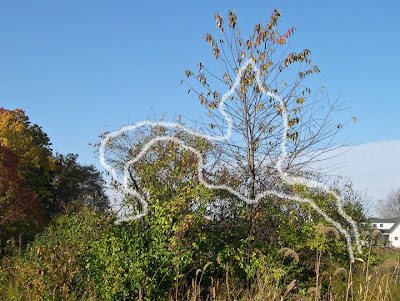
I’ve divided the thicket into three zones that I’ll call the margins, the middle, and the depths. I was seeing mainly Savannah, Song, and Swamp Sparrows, and those are the species I’ll discuss here.
- The Margins are occupied by Savannah Sparrows and are rarely used by the other two species (almost never by Swamp)
- The Middle zone was used by all three species, although I would say it was preferred by Song Sparrow, and was used rarely by Swamp Sparrow.
- The Depths were the home of Swamp Sparrows, which rarely venture into the other zones. Song and Savannah sparrows would also go deep into the shrubs when alarmed (e.g. if a hawk flew by), but their typical behavior when flushed by me was to land on the outer edges of the thicket.
Of course, in real life this thicket is three-dimensional, but the zones I’ve drawn are more like a cross-section. So a Savannah Sparrow could head for the lower parts of the thicket and still land in the margins of that shrub.
This may seem trivial, but it’s really no different from habitat and other “soft” identification clues. You certainly can’t identify a bird solely by its chosen perch, but we should never doubt the capacity of the human mind to discern subtle differences in probability (just look at baseball batting averages). The more I watched the more I realized that these are helpful clues to identification, just as date and habitat are helpful clues. A sparrow that flies right up into the highest twigs of the cherry sapling is almost certainly a Savannah, and it doesn’t take much more to confirm that. A sparrow that goes straight into the deep cover and then barely pokes its head out is likely to be Swamp (or White-throated, or sometimes Song, but at least we can start with some idea of the likely species).
Check it out in your local area. I’d be interested to hear how it works in other places and with other species. And of course the same principle should be applicable to lots of other situations.
Hello,
I have long found this sort of observation to be an important part of my mental birding checklist. I'm very nearsighted, and even with proper eyeglasses (and bins) I can never see REALLY well. When I was a little girl I learned to bird mostly by ear (still do) (and I became a musician!) but I also learned to ID birds by flight patterns and the very types of movements you describe. This morning as I birding by car round the wooded edges of farm fields, I saw 5 spp of woodpecker and could ID them all by the way they moved — the angle at which they flew, the tpyes of branches on which they perched, and the subtleties of their movements once they landed. Endlessly fascinating. Thanks for your fine work and for sharing your discoveries with us.
Hi Sarah, Great comment! I'll have to pay more attention to woodpeckers now. I suspect that all birdwatchers know these things, and use them in the subconscious pattern recognition process. But when we try to describe how we identified a bird we fall back on "general impressions of size and shape" and never talk about the subtleties of movement, habitat, perch choice, etc that probably play a big role in the ID process.
David, you might enjoy this little essay with my observations on how nearly THREE DOZEN different bird species moved in and around one particular tree in just a half hour:
http://quodlibet-sarah.blogspot.com/2009/06/what-good-is-old-tree-anyway.html
but the story had a sad end:
http://quodlibet-sarah.blogspot.com/2009/08/stumped.html
David
During the last week, I became aware of some images of a yellow eyed basic plumaged darker blackbird which did not have rusty tertials or similar colored feather edges on the secondaries or any feathers on the wing for that matter These ‘pale or rusty’ feather edges are cited in the Sibley Guide and apparently also as well as within Pyle as diagnostic for the Rusty Blackbird.
Yet this bird was identified by several experts with no mention of this absence of this feature. Instead, the bird was identified based upon the supercillium/eyebrow stripe and the perception of the shape of the bill. Based upon the Sibley Guide my impression is that both the drab 1st winter male Brewer’e and the basic Rusty Blackbird heads are very similar. (I will forward the images upon request.) I am curious about your views about the features I have mentioned.
Perhaps my post is not appropriate for this thread. This is my first time navigating this site and I am struggling. My apologies for this If I am in error.