


A little-known subspecies of Cliff Swallow in Mexico and Arizona appears to be very distinctive, and I offer a tentative guide to identification (and lots of questions).
- Click to see a Google map showing the distribution of dark-fronted Cliff Swallows. Please leave a comment or contact me with any further info.
Variation in Cliff Swallow has been extensively studied in the north, but most studies have emphasized minor variations across the northern parts of the continent, and this seems to have obscured a truly distinctive subspecies in the southwest. There is only slight clinal variation across most of the continent; e.g. Browning (1992) recognizes only a single subspecies across northern and central North America. There is a cline from larger birds with whiter foreheads in the north to smaller with slightly darker foreheads to the southwest. Browning’s study did not include the southern edge of North America, where a strikingly different subspecies P. p. swainsoni (=melanogaster) just barely enters the US in southeastern Arizona.
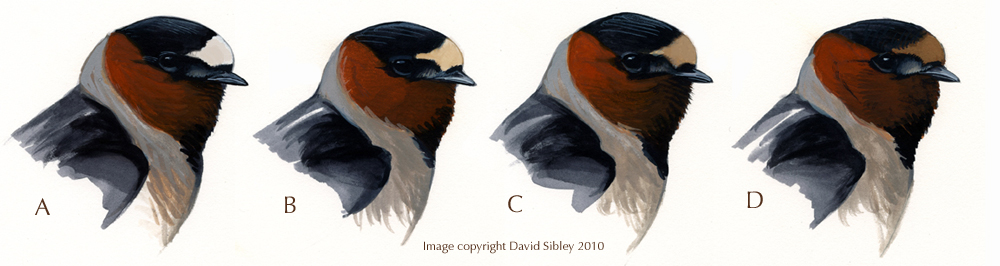
Status and distribution
A few nesting colonies of swainsoni exist in extreme southeast Arizona, including Sonoita, Arizona (where I saw some in the 1980s). Phillips et al (1964) list nesting records from southeastern Arizona along the San Pedro River, Sonoita area, and south of the Chiricahuas, but in the well-studied Santa Cruz Valley they knew of only a couple of late 1800s specimens from Nogales and a single record from Tucson. Oberholser (1974) lists this subspecies as a casual visitor to west Texas with a total of five specimens in Brewster and Jeff Davis Counties.
Interestingly, Phillips et al (1964) report that the nesting swainsoni in the San Pedro River colonies in Arizona do not arrive until late April, weeks later than other subspecies of Cliff Swallow in Arizona.
Here is a Google map showing known sites and percentages of dark-fronted birds. Please let me know if you have any additional info.
Possible intergradation with other subspecies
The Cliff Swallows nesting throughout California, most of Arizona, New Mexico, and Texas are all included in the subspecies P. p. tachina, which is small and somewhat dark-fronted. Even though this subspecies is often described as “dark-fronted”, its forehead is typically buffy and birders would not distinguish these birds in the field from the classic “white-fronted” Cliff Swallows farther north. Small numbers of truly dark-fronted birds, presumably variants of tachina, do occur close to the range of swainsoni. For example, one of six specimens from Las Cruces, NM (MCZ) and a few specimens north to central Arizona (Fort Apache, Wickieup, etc; Phillips et al, 1964). This may be interpreted as intergradation between these forms, although birds with very dark foreheads seem to be quite rare outside of the range of swainsoni. Cliff Swallows with dark foreheads are essentially absent even in Tucson, only about fifty miles from the nearest colonies of swainsoni on the San Pedro River (pers. obs.).
Jeter (1959) remarks that in the colony of swainsoni he watched along the upper San Pedro River, all birds were easily classified as either dark- or white-fronted, there were no intermediate colors, and he identified only one apparent mixed pair among six nests that he watched. Phillips et al (1964) point out that northern birds continue to migrate through Arizona until June and question whether the white-fronted birds Jeter saw were local breeders or just migrants headed farther north.
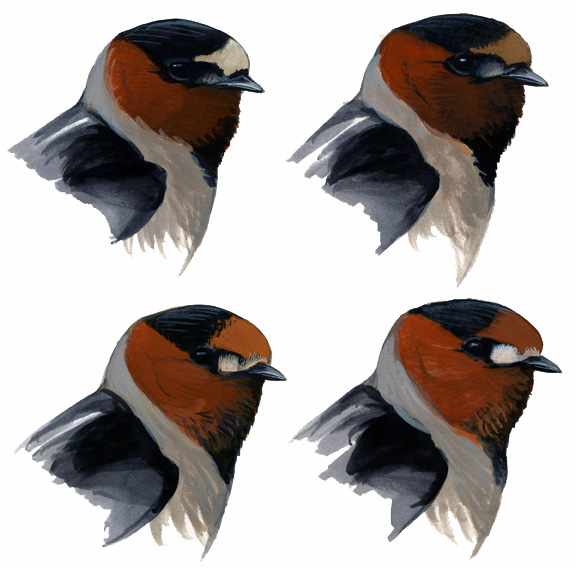
Possible distinguishing features of swainsoni
The following list of potential field marks begins with the more obvious and reliable features and ends with the more subtle and/or unreliable. All require further testing in the field.
- Dark forehead – The most obvious feature and seemingly a pretty good first indication of possible swainsoni; a dark forehead (as dark as the throat) is shown by all swainsoni and by only a small percentage of other Cliff Swallows in nearby populations. In all swainsoni the forehead is about as dark as the throat, varying from drab chestnut brown to rich rufous brown. In the one apparent dark-fronted tachina specimen at MCZ, the forehead was a drab brown, slightly paler than the throat.
- More extensive brown forehead color – On swainsoni the brown forehead extends farther back, to above the eye, while on other Cliff Swallows the forehead color is less extensive and ends forward of the eye. In this feature swainsoni is similar to Cave Swallow.
- Pale lores – all specimens of swainsoni at MCZ (six from Arizona and six from Mexico) have obviously pale whitish or buffy lores, with only a little black around the borders of the feather group. Other subspecies of Cliff Swallow have mostly blackish lores with a small to moderate pale patch there, which might appear obvious under some conditions in the field, but none matched the extensive and very pale patch of swainsoni.
- Pale band above base of bill – The pale lores continue as a narrow pale band across the forehead just above the base of the bill on swainsoni, in contrast to all other Cliff Swallows, which have a blackish band across the front of the forehead. Southwestern Cave Swallows also have a pale band across the front of the forehead, like swainsoni.
- Less black around eye – swainsoni has a more restricted dark cap on average, with rufous-brown cheek color extending up behind the eye (and also with the more extensive brown forehead). In this way they resemble Cave Swallow. The differences in color around the eye are small and hard to see, and some tachina also have reduced black behind the eye.
- Small size – swainsoni is relatively small, but so are the neighboring populations of Cliff Swallow. If one of these birds turned up in, say, Washington or New York, it would probably be noticeably smaller than the local Cliff Swallows, but that would merely suggest that it was from the southwestern region.
- Paler cheeks – the rufous cheeks of swainsoni are slightly paler on average than on other Cliff Swallows, contrasting more with the dark cap, but this is very difficult to judge and probably not useful in the field.
I found no differences in rump color, underparts color, back color, etc.
Summary
The southwestern subspecies of Cliff Swallow P. p. swainsoni seems distinctive in having a very dark forehead and pale lores, as well as other minor differences from adjacent populations of Cliff Swallows. Dark foreheads are sometimes seen on other Cliff Swallows, but apparently only a small minority of individuals, and only within 200 miles or so of the range of swainsoni. These birds deserve more study.
Questions:
What is the true range and status of swainsoni in Arizona? How many colonies? Where?
Do they really arrive in spring weeks later than other Cliff Swallows?
Do white-fronted birds mix with dark-fronted swainsoni in these Arizona colonies?
What is the distribution and frequency of truly dark-fronted birds outside of the limited range of swainsoni?
Do all swainsoni have pale lores?
Are there any differences in voice, nest structure, etc?
References:
Brown, Charles R. and Mary B. Brown. 1995. Cliff Swallow (Petrochelidon pyrrhonota), The Birds of North America Online (A. Poole, Ed.). Ithaca: Cornell Lab of Ornithology; Retrieved from the Birds of North America Online: http://bna.birds.cornell.edu/bna/species/149
Browning, M. R. 1992. Geographic Variation in Hirundo pyrrhonota (Cliff Swallow) from Northern North America. Western Birds 23: 21-29. (pdf here – http://eLibrary.unm.edu/sora/wb/v23n01/p0021-p0030.pdf)
Jeter, H. H. 1959. Cliff Swallows of mixed plumage types in a colony in southeastern Arizona. Condor 61:434. (pdf here – http://elibrary.unm.edu/sora/Condor/files/issues/v061n06/p0434-p0434.pdf)
Oberholser, H. C. 1974. The Bird Life of Texas. University of Texas Press.
Phillips, A., J. Marshall, and G. Monson. 1964. The Birds of Arizona. University of Arizona Press.
MCZ = Museum of Comparative Zoology, Harvard University
Hi David,
I’m about to step out the door for South America, but with regard to your questions about both Mexican Cliff and Cave swallows, I’d say that LSU may be a pretty useful museum collection to you, should you ever be down this way. We have 16 Mexican Cliffs (from Coahuila and San Luis Potosi; identified here as “melanogaster”), and from a quick glance over, maybe only half have whitish lores like those in your illustrations. I didn’t really look at them carefully enough to see what other questions I could answer, though. In addition, a colony at the Pearl River (S Louisiana/Mississippi border) included at least one bird with rich chestnut lores, but it is not clear if it is an abnormal “local” bird or one from the Southwest. I further recall having heard of other “dark fronted” birds being reported from Louisiana over the years, if I’m not mistaken. Steve Cardiff and Donna Dittmann would probably be able to fill you in more on those.
As for Cave Swallows, I did not look too carefully at our series with regard to your questions just now, but it may be of note to you that most (all?) of the vouchers for the Kirchman et al. study are here, so studying the plumages that go with the genes may be of value.
I wish I could be more helpful to you, but I’m a bit pressed for time!
Best wishes,
Dan
David,
As Dan mentions, we do have dark-fronted Cliffs here in Louisiana. It’s a pretty intriguing situation. These birds nest in SW LA and are found mixed in with the more abundant typical pale-fronted birds. From my experience I’d say dark-fronted birds are not all that rare here. I’ve seen many over the past couple of decades and have heard from quite a few other birders who have independently discovered them. I’ve wondered about whether they’re variants or vagrants, but the numbers suggest the former. As Dan pointed out, Dittmann and Cardiff can probably tell you much more…
Paul Conover
Lafayette, LA
Dave .
Just read this. I have for at least the last 7 years commented on various sites that there are two waves of “Cliff Swallows”. I believe I reiterated it again this year on my web site. They arrive early april and as of last weekend were starting to nest build. Some are done and gone, these tend be the ones like the one in the back of my pic I sent you. In fact I have pics still I hope,from last weekend of them gathering mud. Will forward. I have a number of nests that show up late that look like weaver nests.
Will shoot you some pics this weekend of front and faces. Regards Roger
Hi David,
Good timing on this. I have been curious about the Cliff Swallows in Southwest Mississippi. Most have dark foreheads. So far I have only checked 4 bridge locations: I 10 at Hwy 603 in MS, a small bridge at Ansley, I 59 exit 5 in LA, and I 59 at exit 11 in LA (on the MS) border. None of the birds have perched for photos. I do have nest photos, one in MS is most likely a cave nest and I did see one Cave Swallow near the bridge.
I’ll try to get more info.
Later,
Susan
Thanks everyone! I’ve added Susan’s locations and some from Dittmann and Cardiff to the Google map. It would be great to get more details from each location such as a ballpark estimate of what percentage of birds appear “dark-fronted”, and whether the foreheads on the dark birds are the same color as the throat or paler. Donna Dittmann and Steve Cardiff cover this topic briefly in an ID paper here which I will add to the discussion above when I get a chance.
David, P. p. swainsoni are currently nesting at the Windemere Hotel in Sierra Vista, AZ. There are four nests, one in each corner, in the covered registration parking area right at the front door. There were dozens of them vying for these choice sites the first week of May, 2010 and the winners are now nesting. Apparently they don’t nest right along side of each other as is often the case with the tachina race.
Addendum: The nests are shallow cups, not the typical gourd shaped nests.
Hi David,
We have these dark-fronted Cliffs nesting in Alabama as well. I’ve seen them on nests under the Dog River Bridge (Dauphin Island Parkway) in Mobile County. Here is a link showing a dark-fronted bird taken from this location several years ago.
http://www.facebook.com/media/set/fbx/?set=a.1390953268015.50961.1657622249&l=53541592bf
Cheers,
Howard Horne
Mobile, AL
Hi David,
Here is a link to an Alabama Birdlife journal article (Volume 36. No 2) documenting the first known occurrence of nesting dark-fronted Cliff Swallows in Alabama back in 1989.
http://www.aosbirds.org/AlabamaBirdlife/1989/Vol%2036%20No.%202_1989.pdf
Dr. Bill Summerour found these birds near the Interstate 10 Tunnel under the Mobile River (a different location from the Dog River site). The article starts on page 13
Cheers,
Howard Horne
Mobile, AL
Hello David — I first saw the all dark foreheaded Mexican race when first birding in SE AZ in 1967 with a group from Cornell and a few years later when by myself. The local birder Fletcher Sillick was watching a colony nesting on the barracks at Fort Huachuca. As I remember those were all Mexican. In 1998 and in 1999 there was a colony nesting on the back side of the scorebord section of the stands at the west endzone of the football field at the high school in Patagonia. Easily viewed from the road. The colony had both light foreheads and dark foreheads and the nests appeared to be identical.
I didn’t notice any obvious mixed pairs but you could usually only see one bird look out the nest entrance anyway.
R.J. Smith
Washington, D.C.
Hi David and Others
Today the newly started Ecuadorian Records Committee (CERO) (http://ceroecuador.webs.com) had a meeting to discuss records. Among them was a dark-fronted Cliff Swallow, which has not previously been recorded in the country. While looking at this website we realized that it was far more complicated than thought. Here is link to three images, not of top quality unfortunately. We would appreciate feed-back from others on how to treat those.
http://www.pbase.com/ahlman/image/134682028
http://www.pbase.com/ahlman/image/134682029
http://www.pbase.com/ahlman/image/134682030
The late date may suggest swainsoni given what has been written above about arrival time in its breeding range.
Thanks in advance
Roger Ahlman, Quito
I have a mexican cliff swallow with a dark forehead on my balcony and i live in San Antonio Texas. That’s alot farther south than your article seems to let on. My confusion on this is that the cave swallow looks alot like a mexican cliff swallow.. has the same nest it seems too.
David,
I greatly enjoy using your book in the field and was truly scratching my head this past weekend as two birding friends and I faced a mixed swallow flock at Tisma Lagoon, not far southeast of Managua. Swallows seem to be just arriving and we found a pale individual that appeared to be the second record for Nicaragua for the “Texas” cave swallow. It perched next to a darker individual that could be either Caribbean cave or Mexican cliff. I wonder if you might want to weigh in by viewing a few of my friends digital photos? After reading your entry and seeing your new illustrations re: “Mexican” cliff, I’m leaning toward Caribbean cave swallow.
Anyway, if you’d like to see the photos I can forward them to you, if you email me at the address above.
Thanks very much for all your fine work, taking birding to the next level for so many of us.
Howard
Greetings from Vail, AZ. I believe I have a small flock of them expressing interest in my porch. Can I send you photos?
We have a group of Cliff Swallows that just started nesting within the last week on the front porch of a neighbor’s yard in Alpine TX. I just noticed that at least a few of them have dark foreheads so they must be the Mexican (swainsoni).
Hi David, I took a photo of what I thought was an American cliff swallow a couple of weeks ago at the Bear River Migratory Bird Refuge in far northern Utah. Someone pointed out the dark patch on the forehead and told me it might be of the Mexican variety. See link below;
https://www.flickr.com/photos/131037795@N03/27283105483/in/dateposted-public/
This one is of the American variety taken about 60 miles south of the above photo.
https://www.flickr.com/photos/131037795@N03/23049318955/in/album-72157661899476623/
Anyway let me know what you think. I know this is way far north for the Mexican subspecies, but I thought you might be interested.
Thanks Evan
Hello! Your site has been very helpful in identifying the birds which have nested on my front porch in Sonoita, AZ. They do fit the description of the Mexican Cliff Swallow and the young ones should be getting close to leaving the nest here in about another week or so. I’m just trying to make sure the road runners don’t get to them first!
Thank you!
Big colony of Mexican Cliff Swallows ( have been identified) at our place of business in Hereford, Arizona. Big mortality rate as they fall out of the mud nests or the nests fall in the monsoon season and Roadrunners. At lease 15 mud nests.