
A few years ago I was alerted to a subtle difference in the head patterns of Downy and Hairy Woodpeckers when I read a short note by Mark Szantyr with a nod to Julian Hough in the journal The Connecticut Warbler. He pointed out that Downy Woodpecker has a larger white patch on the sides of the neck. In the years since then I’ve looked for this feature in the field and in photos, and it seems quite useful.
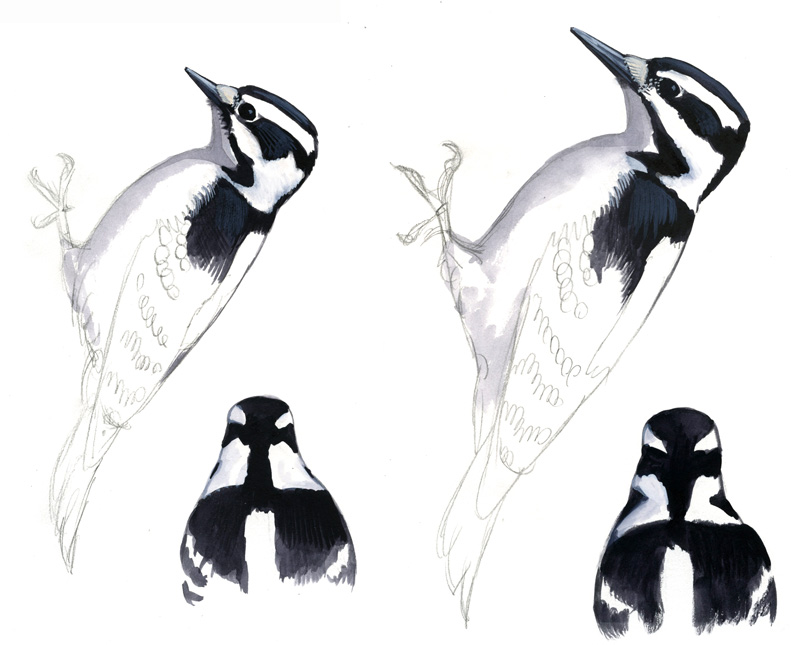
The shape of these white areas is extremely variable as the neck feathers move around depending on how the head is turned, but most of the time it is easy to see the difference, and watching a bird as it moves for a minute or so will reveal the pattern better than a few photos. The difference arises both because the black band behind the eye narrows sharply on Downy Woodpecker, and also because the black band along the lower jaw doesn’t extend as far back. Viewed from behind both of these differences are apparent.
It’s also important to point out that there is a lot of individual variation in the extent of black in the back of the head. Some individuals of both species have the white eyebrows meeting around the back of the head, while others don’t (as shown here). The full white band may be more frequent in Downy than Hairy Woodpecker, but that needs confirmation.
There is also geographic variation, with both species showing more extensive black all over the head in populations in the Rocky Mountain and Pacific regions. The difference in neck pattern still persists though, even though the white areas on the head are reduced overall.
Check it out, and let me know if it works for you.
I saw an interesting Downy Woodpecker last fall–so interesting that I sketched it in a notebook. It had a very white face, so much so that it reminded me of a Red-cockaded Woodpecker (not that I’ve ever seen one…).
Jackson Bottom Wetlands Preserve, Hillsboro, Oregon, 12 October 2010:
“The face seemed whiter than normal, as if the black ear patch was missing or reduced to a post-ocular stripe.”
This was an immature bird, with a thin black forehead and otherwise fully red crown–which is described for the “Gairdner’s Woodpecker” in Birds of Oregon, Gabrielson and Jewett (1940).
Greg Gillson
Beaverton, Oregon
Also, another feature that can be useful in separating the two in male plumage is the red on the nape: in Downy it’s whole across the nape, but in Hairy, it’s split down the middle by a black stripe (connecting the black crown and lower neck).
Hi Dan, Thanks for the comment. I haven’t looked at this nape pattern systematically, but it seems to be pretty variable, both individually and regionally. Maybe that’s because I’ve always lumped males and females together. I’m curious to know if you have observed that male Downys always have a solid red nape, and male Hairys always broken? And also if you think it applies continent-wide.
And of course I’d also be interested to hear from anyone else who has anything to add on this point.
Hi again David,
Since I first noticed this feature, I have paid attention to it when I see Downies and Hairies in new sites. Throughout the East (from New England to the Gulf of Mexico), this pattern seems to hold consistently. Out West, my experience is much more limited (and is primarily in the northern Rockies there), but the times I’ve been able to check, it holds as well. I’ve noted that Hairies in the mountains of southern Mexico and Central America may not show the black divider, but my experience with these birds is very limited indeed.
Unfortunately, specimens are not helpful in trying to see this pattern, as woodpeckers have heads too large to fit through their necks (when skinning them out), so the common practice has been to slice the back of the head to remove the cranium, then sew it up again as the specimen is prepared. As a result, the nape feathers on specimens are not “natural” in their appearance.
In some respects, I suspect that this slight difference in red nape marks, and the facial markings you mention in the body of this post, are interesting clues to the history of convergence in plumages of these two species. Molecular phylogenies have (if memory serves) shown that Downy’s closest relative is Ladder-backed, and Hairy’s is Arizona Woodpecker. Vocally, this makes sense. Thus, even though Downies and Hairies are very similar to one another, this similarity is the result of convergence on a common plumage pattern (and this similarity is, interestingly, maintained geographically where the two coexist: duskier with fewer spots in the Pacific Northwest, whiter with fewer spots in the Rockies, and whiter with more spots in the East). So the question is: why the apparent plumage mimicry?
Perhaps birders out there, particularly in the West, can comment more on the variation (or lack thereof) of this red nape-spot pattern within Downies and Hairies?
Good birding!
I recently seen a woodpecker with the top of his head red,otherwise looks like the downy.The size is nearly the same as the downy.Does the downy get more red than the red stripe on his neck with age? Or am I seeing a different wood pecker?I have never seen a downy with so much red.
That sounds like a juvenile, and this is the right time of year for them. Young birds just out of the nest often have red on the center of the crown, mostly males (females have all-black crowns or just a few red feathers). They will soon molt into adult-like plumage.
I’ve seen the same kind of Downy like woodpecker at my backyard feeders! Looks exactly like a Downy except for a rusty/red cap. I’m in NY and yes all the juveniles are out!
There is no mention of the banding on the tail feathers. It seems the Hairies do not have any that I can see on the underside of the tail. Does this hold true between Downies and Hairies?
I have a male hairy woodpecker in my yard this winter. It has a lot of brown on the sides of the tail. Is this a first year male?
Jean
Hi Jean, brownish color on the outer tail feathers of woodpeckers is usually staining from the feathers constantly being pressed and dragged across the bark of trees.
I have 3 very large woodpeckers who I have been feeding, they are the size of a small pheasant, they have a very large red on the top of their heads. They are truly amazing and my friends have never seen any this big. Wish I knew what kind they are and are there a lot of them in northern Michigan!!!
Hi Patty, Those are surely Pileated Woodpeckers – the size of a crow (or pheasant) with a big red crest on their head. They are scarce but widespread in eastern forests, but increasing in the last few decades in regions where forests are recovering from the intensive land-clearing of the 1800s. Enjoy, they are fantastic birds!
I read somewhere that another difference between a hairy and downy is the black comma-like mark on the shoulder just where the top of the wing joins the body. The Hairy has this “comma” while the Downy does not. Not sure if there is variability to this particular pattern detail within the Hairy population or not. It would be worth checking out. Also, I am wondering if the two species ever cross-breed. Anyone know? Thanks
Pingback: Getting down with the Downy Woodpecker - wcn247.com
There’s an interesting Downy/Hairy woodpecker in this checklist:
https://ebird.org/view/checklist/S44299744
Tail would seem to indicate Downy, head Hairy no?
That one is clearly a Hairy, but listed by the birder as a Downy (the same list also has a Veery photo listed as a Hermit Thrush). Atypical tail, but otherwise all Hairy characteristics.