

Ivory-billed Woodpecker Campephilus principalis
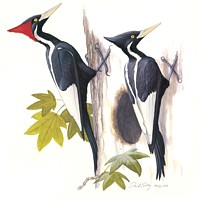 Not included in the Sibley Guide to Birds (extremely rare, presumed extinct).
Download a page on identification of Ivory-billed Woodpecker (pdf file) for your Sibley Guide to Birds
The claimed 2004 rediscovery in Arkansas
Since the last confirmed record of Ivory-billed Woodpecker in the US (1944 in Louisiana) there have been many claims of rediscovery. The most recent began with the public announcement in April 2005 that one bird had been seen and videotaped in Arkansas. The scientific publication presenting the evidence is:
Fitzpatrick, et al. 2005. Ivory-billed Woodpecker (Campephilus principalis) Persists in Continental North America. Science. 3 June 2005. 308: 1460-1462.
The key piece of evidence in this claim is a brief and blurry video clip captured in April 2004 near Brinkley Arkansas, by David Luneau.
Along with many other birders and ornithologists, including Jerome Jackson, Rick Prum, Mark Robbins, and Kenn Kaufmann, I became skeptical soon after reading and reviewing the evidence. In March 2006, three colleagues and I published a response to the original claim. Our conclusion is that all of the features shown in the video are consistent with a normal (and common) Pileated Woodpecker and therefore there is no verifiable evidence to support the claim that the Ivory-billed Woodpecker has been rediscovered.
Sibley, David A., Louis R. Bevier, Michael A. Patten, Chris S. Elphick. 2006. Comment on “Ivory-billed Woodpecker (Campephilus principalis) Persists in Continental North America”. Science. 17 March 2006: Vol. 311: p. 1555. Supporting Online Material
Fitzpatrick et al. responded by insisting that most of their original interpretation was correct, and that ours was flawed, without directly addressing our key points:
Fitzpatrick, J. W., et al. 2006. Response to Comment on “Ivory-billed Woodpecker (Campephilus principalis) Persists in Continental North America”. Science. 17 March 2006: Vol. 311: p. 1556.
Louis Bevier has a detailed website addressing many of the questions surrounding these claims.
In 2007 Martin Collinson (website) independently analyzed the Arkansas video, comparing it to video of a known Pileated Woodpecker in Ohio, and concluded that “there are features of the video of the bird in Arkansas in 2004 that are inconsistent with Ivory-billed Woodpecker, and the video is equally, if not more, consistent with Pileated Woodpecker.”
Collinson JM. 2007. Video analysis of the escape flight of Pileated Woodpecker Dryocopus pileatus: does the Ivory-billed Woodpecker Campephilus principalis persist in continental North America? BMC Biology 5: 8.
A brief discussion of my analysis of the Arkansas video is here.
In 2007 I wrote two detailed articles on my blog discussing various aspects of the claimed rediscovery:
Ivory-billed Woodpecker – status review
“After three years of fruitless search efforts, with several studies refuting the original claim and not a single independent study supporting it, it is grossly misleading to suggest that the evidence is “convincing” and it is irresponsible to place the hypothetical needs of this species ahead of the known needs of so many others.”
“The sound (even though it too was ambiguous …) helps cross a decision threshold – that Ivory-billed is likely, that the white really did seem to be on the trailing edge of the wings, and that the bird that just flew away must have been an Ivory-billed.”
To date (November 2009) there is still no verifiable evidence that Ivory-billed Woodpeckers survive in the US.
Findings are summarized in the 2010 Recovery Plan for the Ivory-billed Woodpecker
Although I’m not a ornithologist with extensive education on the subject ( neither was Audubon ) I have seen hundreds of Pileated Woodpeckers flying away from me in my life and mostly in escape flight I might add. Never once in the many times I have observed the Luneau video did I feel I was looking at a normal Pileated. The wings seem too long and not as stubby as a Pileated. Also, about midway through the sequence the birds goes with a bit more power to gain altitude and I see it thrust its neck and head more upward. During this time the bird appears to have a longer neck than a Pileated. And basically, overall the way it flies is just wrong for a Pileated. Another good vernacular name for the Pileated could be “The stubby winged woodpecker” as far as I’m concerned. I have since studied many filmed sequences of Pileateds in flight to refresh myself with the bird, having spent a few years lately in Utah and Idaho. Again, I would not think the Luneau bird looks like a Pileated. I’m more of a raptor specialist but that does not mean I don’t know my woodpeckers.
Mark, I could go on for pages about why the video can’t be an Ivory-billed. I understand what you’re saying, the video didn’t look like a Pileated to me when I first saw it, but I think the video is essentially irrelevant now. It is so blurry and ambiguous that viewers can project whatever they desire to see there. Fitzpatrick et al’s original analysis was seriously flawed and their conclusions were overblown, and later independent analyses (mine, and Collinson – see above) pointed out the mistakes in Fitzpatrick’s claims and showed that the video fit a Pileated Woodpecker. After millions of person-hours of searching, no real proof was ever found, and now even Cornell admits (quietly) that there are no Ivory-billed Woodpeckers in Arkansas.
David, thank you for all the time you’ve spent on this case and its attendant issues over the years. I teach about the ivory-billed woodpecker, and have always found your insight adds great value to the discussions. I have one question I’ve been meaning to ask for some time, regarding the comment you make above: where have you found indication of Cornell folks’ admissions that the bird does not persist in Arkansas? (I recognize that you wrote the post above in 2010; I am assuming that the status has not changed in the intervening years.)
In 2010, the head of the CLO search group Ron Rohrbaugh said, “We don’t believe a recoverable population of ivory-billed woodpeckers exists.” Source: http://www.nature.com/news/2010/100210/full/463718a.html
Mr Sibley, one question? Have you or any of your esteemed co authors ever seen a Ivory Billed Escape flight to compare this video too or is it just easier to compare to what you know. Next question? Where does it say that Cornell Lab queitly admits it doesn’t exist. From what I have read there stand is there is not enough of a population to let the bird survive. My opinion which you probably will disregard is they went about this search all wrong instead of putting a large crew in place stealth is best. As a hunter and my first love of birds the only way to see wildlife is being quiet and taking your time. I know how these people feel. When I was 11 yrs old on my aunt’s farm in marshall, Wi. I saw my 1st pileated woodpecker no one believed me until last year when they where sited again in the area some 33 years later as a hunter in Wisconsin I see Pileated’s every year and what I see in the video and what I have seen in real life are two diffirent birds. I have seen pileated’s in Wisconsin, missouri, Virinia, Texas, Illinios, and Kentuckey all fly the same when scared not like the video and trust me I am a pileated fan I have a wild life print and other items. Because it was my first major discovery of birds in my life. If I had the time and money I would go to the area’s of this bird and look for myself with a small crew like it was done in the 1930’s. The right way! It would take a while but some where pictures and video would come out with proof I don’t believe this bird is gone but I also don’t believe the population is going to survive the next 50 to 100 yrs. Due to a 20 to 30 year life span the birds being seen and heard today are the remminants of what survived from the florida, singer tract and the big Thicket populations. The feds should have stepped in sooner when the laws where allowing for people to go out and shoot them for them selves or in Texas when a male was shot just so the gentleman could prove to the Texas wildlife and Fish service would beleve him that he saw it. It is time to start listening and not being such a doubter on this. It is people like you that will surely put this bird in with the passanger pigeon and the carolina parakeet.
Andrew, As I replied to Mark the video is essentially irrelevant now. Everyone has done their analysis and there is no consensus. So, contrary to Fitzpatrick’s original public statements that this was “rock-solid proof”, the video has no value as evidence. The only thing that can influence the debate now is substantive new evidence, but none has been found, and there are hundreds of other species that could go the way of the Passenger Pigeon while we are distracted by the vanishingly small possibility that Ivory-billed Woodpeckers might persist. If people want to keep searching that is their business and I don’t criticize that. I choose to focus on other things.
Hei guys, don´t fight, we are in the same vessel.
I do know that their are other specie’s of birds and other wildlife need our attention too. But what gets me that some one of your stature is kind of quick to denounce what others saw with their own eyes. I’m not here to fight or ruffle you color but have have never read the fact that there is concrete proof that the bird does not exist. Neither you nor I know that answer for sure and probably never will. I just wish that if it does people leave it alone. They we have done enough to destroy the flora and fauna of this nation. My hope one day is that this bird does come back like the Whooping Crane or the attempts they are trying to do with the Kirtland’s Warbler but this bird will need the help of a lot more. anyway I have spent time at my local book store, Border and Barns & Noble looking at the bird guides that you have authored. I have not bought a new bird guide in 20 years because I own so many and they are getting worn from the years of use and with my children being only two and five and they spend time with me watching birds and other wildlife i thought it would be time to up date my guides. I was sadden when I was looking through yours that you don’t even mention the possibility that this bird might still exist. Even though I like you guides the best I still have some thinking to do.
Hi Andrew, We’re not far apart in our views. And it’s true there is no way to prove that the Ivory-billed Woodpecker is gone – as some like to say “the absence of evidence is not evidence of absence” – but a long period of intensive searching without any real confirmation does offer some “evidence of absence”.
I do disagree with your comment that I have been “quick to denounce what others saw with their own eyes.” and I hope you’ll consider my explanation: First, what we see with our own eyes is open to all sorts of “fudging” in our brains, and there are endless examples and scientific studies of this. Second, I have tried hard not to “denounce” anyone (except maybe the Cornell team that launched and promoted this whole debacle – they should have known better). I know first-hand how easy it is to misidentify a bird, and how embarrassing it can be, and I have simply tried to point out that the observers could have been mistaken. I’ve written about my own mistakes, making the point that misidentifying birds is not lying. It just means we were tricked by the play of light, or by our expectations, or any number of other things. And it’s especially easy to be tricked when the sightings are as brief as all of the recent Ivory-billed reports. Finally, I don’t think I did any of this quickly. I became skeptical of the video a couple of weeks after it was made public. By that time there had already been over a year of intensive searching and the best evidence they could show was the blurry video and a few brief glimpses. I waited another three months, agonizing over what to do, studying and restudying the video, before I said anything publicly about my skepticism, and my colleagues and I published our paper refuting the video almost a year after the announcement. I’ve said very little about it since then. So far, I think the evidence (or absence of evidence) has supported my interpretation of the video, but I get no pleasure from that.
The thing that upsets me most was that so much time, effort, and money was being poured into a bucket that was obviously leaky.
As far as including the species in my field guide, there is no right or wrong approach. I made my decision around 1995, and I left out Ivory-billed Woodpecker for the same reasons I left out Bachman’s Warbler, Eskimo Curlew, Green-breasted Mango, etc – there simply weren’t enough verifiable records of the species in the past thirty years to meet my criteria for inclusion. I also didn’t want to give the casual reader the impression that they might see any of those species, because creating that expectation leads to a lot of misidentifications. On the other hand, better information can prevent misidentification, so I now have the Ivory-billed Woodpecker page here on my website for download.
Appendix B of the Ivory-billed Woodpecker Recovery Plan (http://www.fws.gov/ivorybill/pdf/IBWRecoveryPlan2010.pdf) is quite critical of your analysis of the Luneau video, indicating that your interpretation is “based on misinterpretations of video artifacts as plumage, and novel interpretations of typical bird flight”. While I’m sure you disagree, it seems like there is no harm in allowing for the possibility that the Fish & Wildlife Service, Cornell, Bill Pulliam etc. are correct and you, Collinson, etc. are incorrect about the Luneau video since as you say it is irrelevant at this point anyway. We all look selectively at evidence which supports our own interpretations in cases where a conclusion is not immediately clear, and as you make clear you apply that standard to yourself as well as to others like Cornell. Your statement, “And it’s especially easy to be tricked when the sightings are as brief as all of the recent Ivory-billed reports” is itself selective since Appendix F of the Recovery Plan lists several detailed and/or extended sightings. Indeed, the Kulivan sighting which began the recent attention to the Ivory-billed Woodpecker was a close observation of a pair of birds for 10 minutes.
Thankfully, there is alot of convergence between those who assert one thing or the other in the Ivory-bill saga or take a more agnostic view. As a practical matter, I think all of us across the spectrum agree that the right course of action is to do nothing for now. The gradual recovery of bottomland habitats gives us hope that if the Ivory-bill has there wherewithall to persist, it will have the opportunity to do so. Personally, I think it’s pretty cool that the Ivory-bill has flummoxed us all and reminded us how much we don’t know about the world around us.
Dear Sir. I find the last part of your comment, excellent words to consider. The increase of favorable environment will give any (if there are any) Ivory-billed the place to propagate. If they can and will, they need that chance. Doing nothing to promote or hinder the animal is also a good strategy. The few humans that interact with the bird should do it on it’s terms within it’s environmental conditions. I have proof that that technique works.
I’m not here to ruffle your collar. Sorry about that but the boy was talking about coloring.
Hi Mr. Sibley, I have done a lot of reaserch and reading on the internet about you and some of your fellow ornithologist and you are the only one at this time that I have found real respect for. For someone of your class to spend the hours,days and years as you did out putting your dream together and drawing and painting your birds from life and not museum specimens hats off to you. I just wonder what three specie’s you couldn’t paint from real life? My bird bible is Birds East of the Rockies By Rodger Tory Peterson, I own 3 copies all which are over 25 yrs old. But I own over 30 Different bird books that I have collected either by gifts or purchase at yard sales or used book store’s. In my life I never got the pleasure to meet my three influences that would have been the father of conservation Aldo Leopold and my two bird men Peterson and Owen J Gromme. Anyway as in life get back to the real item we have been going back and forth about. I have done a lot of reading about the ivory bill and my conclusion is that we don’t know and never will! But I will tell you a story in 1988 I was in the army stationed at Ft. Hood, Texas my buddy and I were in north east Texas after we had one of our weekends of partying and took a wrong turn and that’s how we ended up in the oppisite direction of the post as we pulled in to a little cafe out in noman’s land he climbed in the back seat to sleep and I went inside as I was sitting there paging thru an audobohn magizine an older lady started talking to me about general crap and we got talking about birds and I told her how I got intrested at an early age and she told me that when she was between the ages of eight and eleven her grandfather would take her out to an area by there land every spring and they would canoe around until they found a nesting pair of ivory bills. She said they did that until he passed away. He had told her never to mention it to anyone cause he didn’t want them shot. She was eleven.when he passed. She was 68 in 1986 so if I did my math right that would have made it about 1928 to 1931. then her name was Grace. when Grace was 30. Her husband and her went out and looked because she wanted to see them and remember her grandpa but they looked for 4 days and never heard one let alone saw one so she figured they were extinct. I figure this to be about 1950 or so. So she proceeded to tell me that her 30 year old son was home on leave in 1966 a military career man and that he was out canoeing doing a little fishing in early april. When he had gotten home that evening he describe to a T what she believed to be an ivory bill nesting and she made him promise to take her out to the site after he got back from Vietnam but he never made it home. So 20 yrs later when she was talking to me she had said that she believed him but that she would never tell anyone. And that they probably were not around anymore So as I read all this internet crap and a lot of it is crap you kind of have to filter out the junk. And know what to look for. I did and do believe her story because that was about the right time frame. As for the Big Woods I don’t know what they saw and I can’t argue with someone like you. When you have more knowledge about these birds than I do. But this Dan Rainsong Claim looks a little crooked. As for myself everything I have learned I did on my own. Except for my wife and kids and the my hunting dog. Birds are my 1st love and I have spent many years watching and listening to there calls and have studied many books on them. Thus is why over the past couple of days I have orderd Tanner and Hoose’s books on the ivory bill just to read about a bird I want to know more about it. Any how I do like the fact you do reply and that I can ask you for your opinion since your older by 3 yrs. (Haha) maybe someday we will meet hope all is well and thank you again. Hey patch that leaky bucket. Hey Mr Sibley, you never gave me a reason why I should choose your book over anyone of the other ones its time for my bible book to get into the 21st century. To me and more than your average joe birder want a book that includes extremly rare or extinct birds so my children learn the right way this is what happens when you don’t protect or manage the right way. That’s just my opinion.
Here is what I say about the Ivory Billed Woodpecker. I could go out tomorrow to Fla, Ark, Tex, or La and see a Ivory Billed Woodpecker and come back and report the sighting. I would be told I had to see a Pileated (sic), not a Ivory Billed. I could go out later and take a picture with a normal Didgital (sic) camera and I would be told that the picture is not good enough to make an identification. I could then go out with a good SLR and take a picture. I would then be told that either it is of a stuffed bird or some kind of a fake. I then could go out and video the bird for 10 min or more. Still would be told it is not a Ivory Billed, would not matter how good the video is. One reason is I am not a certified bird watcher, scientist, or other qualified individual, or a well known scientist. Yes I have hunted all my life, duck hunted a lot, in flooded timber where Id is quickly required. Yes I have watched hundreds of Pileated (sic), been doing that since 8 yrs old. Have observed them in Fla, SC, Ga, NC, and Miss. Sometimes watching the Pileated for hrs while sitting in Deer stands and Turkey hunting. Yes seeing them fooling around for long periods in a section of woods. I am 61 now. Now that leaves only two options to prove if I really saw what I said. Capture the bird or shoot it, both of which are illegal.
Do I think there is a good possibility that the Ivory billed survives, yes. Do I believe that some of the sightings in Fla through the 50’s, 60’s and 70′ are probably factual? Yes I do. Very good possibility.
Mr. Clegg, are you saying that you have seen an ivory-billed woodpecker? Reading your and other woodsmen-hunters’ stories almost convinces me that it’s possible. After all, you are out there and have been for many decades, watching and listening.
I recently read on the Discover website that Guantanamo Bay U.S. Air Force Base in Cuba is a Gallapagos of the Caribbean because the indigenous animals (hunted and eaten elsewhere on the island) are not hunted on the site, and that it preserves many endangered species. A woodpecker was mentioned, but not the ivory-billed. I had hoped that the scientists would at least mention it, but that was not so.
I share the website’s patron’s concern for listing extinct or near-extinct species so that new generations will know that losses have occurred and are still occurring: e.g. I recently read that 8 species, including a small red hummingbird-lookalike, have disappeared on Guam in the recent past, under American governance. I had no idea.
I can’t weigh in on the wisdom of preserving IVB habitat over other endangered creatures’ habitat, because I don’t know the facts. But–okay, I’m kind of weighing in–why not preserve the habitat for the sake of the other species that need it?
Anyhow, thanks, David, for holding the space and replying to the public on these kinds of issues.
To Carol Long
No I have not seen an Ivory Billed Woodpecker. Wish I had. Just saying that if I had I would probably have to catch it to be believed. And yes I do believe there is a great possibility they are still around. There are still some very wild places around.
Mr. Clegg. I understand your position and feel a standard of quality was set by Mr. Tanner and Kohl in the 1935 (black and white video) of the Ivory-billed Woodpecker. Your sentiments seem to hold merit with the dismissal of most evidence for that reason. A video like the one I shoot of a mated pair of Pileated Woodpeckers is not possible often. It took three years to gain the trust of the specific birds I show in this clip – https://www.youtube.com/watch?v=oI5AXKoJO5k.
I have begun a project to capture a nest or roost site as well as hunting behavior of the Ivory Billed (alleged extinct) Woodpeckers in my area of Central Mississippi. I may not get the same quality of film as I did with the Pileated, but I will do my best.
Well you are one of the few. I have always thought that there is some romote location in the south that they might possably exist. But after reading james a tanner’s Book and phillip Hoose’s book on the ivory bill they leave little room for the bird to exist. As Mr Sibley put it they are throwing good hard cash away on one bird that they cannot locate again. What they really need to put their focus on is the here and now. NO ONE has really said any thing about the massive kill rate on migrating birds caused by the wind energy farms. More research should be done on how to detour birds away from them or put more money to real education on how to preserve land for all species and not just one. You can’t blame Cornell or any of the rest of them for looking but after 4 years and no repeat pictures proves it just wasn’t there. The birds were not that secretive read the race to save the lord god bird and learn how the idiots like Alexander Wilson, John James Audobon and Goerge Beyer went out found the ivory bills and shot them. for collections they did not try to collect one or two birds but to keep killing them almost out of greed. Beyer made me sick to my stomach knowing full well the species was in decline and shot seven of them in one week. Including a whole family. Yes I hunt but what I harvest goes on my plate for my family and I. It almost sounds like they did it for fun at times. Now as far as birds surviving today little if any chance at all. The singer co. made sure of that. Their niche in the wild was too sensitive all these sightings that go on in the last decade or so and no one has ever seen the birds again it makes you wonder. You have to ask yourself what was it they really saw there. Which leaves one question do they really exsist. I will let you wonder that I came to my own conclusion after I read those books. Yes I do believe they did survive into the mid 1900’s but only stragglers with the increase of outdoor activities over the past couple of decades if they did exsist they would have been seen and documented
Uhm. No reply from anyone. I wonder why that is. The kulivan sisgting was another expensive exploration that yeilded no more sightings and nor did they here any kent calls so once again this expensive and fruitless hunt for a bird that has not proven that it exsit in decades and the millions of dollars that have been thrown at it could have been used some where else. Let’s take the time and reflect on all the searching and hunting for this bird in the last decade and nothing. It is what it is. And that’s a memory caused by the idiots that killed them for there own collections and for specimans. This is the reason I am not a fan of the Audobon Society.
Hi Andrew et al. I’m just getting some time to look back at this for a brief reply. When I left Arkansas after about 8 days of searching in early May 2005, one of the things that struck me was that everywhere I went I met hunters and fishermen, and all of them knew about the “rediscovery”, and they were all looking and carrying cameras. I drove home thinking “If this bird still exists, somebody will find it within a month” because there was so much excitement and every acre of that swamp was hunted or fished at some point. Putting a small team of expert birders and some automatic cameras out there was a good backup, but that couldn’t begin to match the coverage provided by duck hunters, deer hunters, turkey hunters, fishermen, foresters, and all the other people who live and work there.
So now we have to refocus, find some other conservation issues that need our attention, and try to be objective and realistic about how we approach those.
Hello – I have seen the Luneau video myself, of course, and I cannot believe that anyone could think that this is a video of a Pileated Woodpecker. I have seen many Pileated Woodpeckers in my lifetime as well, from Florida to California, and I have been a bird watcher all my life, so I do know how to identify birds. Sometimes I think there is a lot of professional jealousy involved here, and it makes me sick! Mr. Sibley, if you had taken this video you would certainly conclude that this was an Ivory-billed Woodpecker yourself.
It is devastating to lose a majestic bird such as this to extinction, and I mostly blame the Singer Company for a major part of this bird’s disappearance. Of course, I also blame the hunters who killed this and other birds just for sport. I do hope that most hunters’ attitudes have changed in more recent years. Of course, it is illegal to do this as well, but I’m sure this is something that is not easily policed.
I know that resources are limited these days, and it does take lots of money to try to find more individuals of a nearly extinct species. But there is something very inspiring about it. My father grew up in Michigan in the 1920s, and found a teenaged boy who lived nearby who would take him and some of my father’s friends out to go bird watching. This became my father’s most passionate pursuit during his lifetime – to look for birds, to photograph them, and to teach others the wonderful pursuit of bird watching. The teenaged boy who inspired my father was Lawrence Walkinshaw, who became a world-renowned crane expert. I was privileged to meet Dr. Walkinshaw in Michigan, where he was working with others during the nesting season of the Kirtland’s Warbler, to identify individual birds, to keep nesting records, and other endeavors. I was astonished to see all the work these people were doing, and I felt very thankful that there existed people who could care so much about one bird species. I wish more people did.
At this point I think the best way to try to save the Ivory-billed Woodpecker is to make sure the area where the bird was taped never loses any more of the habitat. It doesn’t seem, so far, that exploring this swamp has helped in the efforts to locate any other individuals. It may be that the bird in the video is the last Ivory-billed Woodpecker to exist. Anyway, only time will tell. Leave the swamp alone and see what happens.
Well here we go again. I just read about the IBW recovery plan. What a joke let’s throw millions of dollars away on a bird that doesn’t exist. Once again I refer to Hoose’s book “the race to save the lord god bird”. Doesn’t he refer to J.J.A. To saying it WAS a bird that you could here for long distances. What about all those present day hunters and fisherman who spend a lot of time out in the big woods. How have any of them claimed to have heard or seen it. Let’s not forget all the money Cornell University Dropped on the search for a hopeful glimpse of a figment of there imagination. Not one shred of new evidence after 4 years. Let’s call it what it is one person got overly excited on what they thought they saw and everyone else jumped on the band wagon. I’m quite sure that pileated’s must have color variations to some degree. It is all over the animal kingdom. Just look out your window at your bird feeders. At sometime your gonna see a sparrow or cardinal or even a woodpecker that is gonna have more white or black or some variation of color on it that it shouldn’t. In 1992 we had a male cardinal that was almost gray. We nicked named him the ole guy. In the Spring when the oriole’s come back not every male that comes to our feeder is not the bright orange and black. I’m a hunter and a nature lover. But I know other hunters can relate to this. On opening morning of gun hunting as the night gives way to the morning light. Your eyes play games on you and your senses. You think you see antlers in the brush. Is that shadow a deer buy that fallen tree or is that clump of brown marsh grass blowing in the wind a deer moving. But when you focus and let your senses take over you realize it’s just mother nature at work. As for the IWB. The research done by Tanner proves the bird never shut up while foraging through the woods. Which made it an easy target to find. This last search wasn’t 3 people with equipment wading through the swamp with mules and a wagon. It was 100 different people in boats, canoes, and kayaks with all kinds of equipment and still no proof. Let’s focus on something that we are able to save.
I want to make another comment about my challenge to David to engage in a public debate on the Ivory-bill. I know this is not the exact thread where I posted previously, but so it goes….
I deplore Photography bird guides. They seek to depict a moment of 1/1000th of 1 sec as typical of a species. To me there was a moment, (and I have often expressed this in the classes in which I taught beginning birding) of the perfect field guide. To my way of thinking, RTP’s 1953 guide was about perfect. A field guide is not a Robert Bateman study in plumage detail. It is an aid to identification. The very simple patterns which Roger beautifully picked up on, were the key to several generations ability to improve as birders.
My comments to my classes over the years, have always lauded David’s illustrations as perhaps the perfect blend of just the right amount of detail and just the right amount of pattern coupled with an artists eye.
So my invitation to a debate the identification of the Luneau video is not an attack on David’s character nor a criticism of his work in any way.
David and others who have criticized the video, have lumped our efforts to document a bird which was frequenting Bayou de View, Arkansas into what tonight in Lawrence, Kansas is being called a “Fantasy”.
As a professional film-maker who has spent years developing my craft and skills, who excels in field identification and yet was unable to obtain any footage of a bird which was so elusive but definitely present, I am offended that there are peers of mine who consider that I am suffering a fantasy.
Therefore, I have issued a public challenge to David as I consider him to be a reasonable person, (normally) possessing a sound mind and a very talented individual who might accept this in order to benefit the birding community by conducting a balanced deabate instead of using tactics which are neither fair nor reasonable.
Sincerely,
Timothy R. Barksdale
Birdman Productions
Choteau, MT & Prairie Village, KS
Tim, I have never criticized those of you who were out in the field in good faith searching for better documentation of Ivory-billed Woodpeckers. The only fantasy came from the Cornell team believing that the evidence they presented was “rock-solid proof” and “irrefutable”. If only they had been more realistic in the way they presented the evidence in that first announcement….
The video is so ambiguous that anyone can see whatever they want in it. My colleagues and I have published our interpretations (links above) and we’ve shown that an identification of Pileated Woodpecker is plausible, even likely. The claim that it is definitely an Ivory-billed has been refuted. I’ll be happy to answer specific questions, clarify or expand on my interpretation of the video, and respond to any new evidence. Just send it along.
Hello. About the ivory billed woodpecker, I have communicated a sighting to Cornell University Dept of Ornithology, which they have accepted, about my experience here in the northern part of Philadelphia. One winter’s night four year’s ago (after the news of the ivory billed woodpecker’s alleged rediscovery), when there was some unusual lunar event, I was standing on my street corner at 10th St and Oak Lane about 1 am with my dog. I heard a “tap tap”, and then this bird flies out of the wooded lot (3rd from corner to south of Oak Lane on 10th st) and it glides up 10th st and crosses the yard of the church across from my house on south west corner, flies around some large cedar trees and glides into Oak Lane, takes several strong strokes, goes up and over a large sugar maple and on down Oak Lane and out of view. The two key things I notice immediately were (1) the bird was very large, it was “Oh my God, that’s a large bird” sized. (2) it has a white band across the top rear wing feathers and this stripe went from wing tip to wing tip practically, and was not a thin band but a deep band. I took zoology in high school and had to create a bird list and have been on several bird counts, and I have never seen this bird before. There had been four hurricanes that fall that had come up from the Gulf of Mexico towards New England. Could this have been a solitary blown north? We have wood peckers such as flickers, yellow bellied woodpeckers, downy and hairy woodpeckers. I have subsequently seen a piliated woodpecker in NJ. We had a snow owl one winter and a barred owl. We have ravens, turkey vultures, red tailed hawks, and other hawks. I need a list of all birds with a white band on the top rear of the wings. I checked the ivory billed woodpeckers at a local museum, but none are mounted with their wings extended, and most specimens I saw were rather small. Regards, T Michael
David, first let me thank you for hanging on to you “scientific side” and not letting your love of birds interfere with the task at hand. I saw “Ghost Bird” last night in Lawrence KS and a couple of things struck me, one being the comment you made about feeder trees. If you are not seeing feeder trees then there are no IBWO (or PIWO for that matter). Finding and monitoring these trees would be far easier than trying to find the nest cavities. The second thing that I noticed is that it seems to me that far too much attention is being paid to the wrong part of the flight segment. There is a split second in the video where it appears that you can see the primaries of one wing. By studying this segment maybe the orientation of the bird can be determined which will then allow us to see where the black and white portions of the bird are in relation to that orientation. I downloaded your Ivory-billed supplement last night and you show no more than five primaries being black so this should be of help if more than five are visible in the video.
BTW I love your guides, I just wish the covers of the small ones were as pliable as the old RTP guides
BTW is there somewhere I can view the video in its original format. The enlarged, pixelated images like the one on this website are of no use.
Brandon, Thanks for your comments. When you say that the “enlarged, pixelated images” from the video “are of no use” you have hit the core of the problem. That is all we have, and there is very little information there. Separating Ivory-billed and Pileated Woodpeckers should not be difficult, but it is when you are using images only a few pixels across. I’ve posted a new subpage with slides from a presentation I gave a few times back then. It discusses the limitations of the video, and summarizes the key identification points. You can view it here.
Given the ambiguity in the analyses and the brevity of various sightings, etc. I think the truth on whether the IBW is extant rests more on David Kulivan’s shoulders as he is the only person who got a good, close, and long view. I’m surprised all concerned have not requested a more current interview with him, possibly including a lie detector test. He may want to avoid any more public attention, but on the other hand if he really did see the IBW, one would suppose that no matter the hassle, he would willing come back into the spotlight and take a lie detector test on his own accord.
What is your take on this David, have you met him and if so, what can you tell us? It is very surprising that no one is keying in on this, IMO.
As far as I’m concerned “the truth” can never rest solely on the testimony of an eyewitness. That’s the generally accepted standard in science and in law. What set the Arkansas episode apart from other recent claims was that they claimed to have verifiable evidence in the form of a video – something that anyone could look at and analyze. When other people analyzed the evidence they reached a different conclusion (that it could be a Pileated Woodpecker). David Kulivan might have seen a pair of Ivory-billed Woodpeckers, but there is no way we can go back and verify his sighting. No in-depth interview or lie detector test can verify what he saw. That’s why the video was the center of the scientific debate, and why indisputable photos or video will be the key to confirming the presence of Ivory-billed Woodpecker.
Mr. Sibley makes an excellent point: that Cornell’s descriptive analysis of the Luneau video has proven to be inconclusive, and that his own analysis is “suggestive” (could I say “inconclusive”?). (I disagree, however, with the assertion that the video is irrelevent when used by one side, but still useful when used by the other.) Reviewers have looked at the same frames, and come to completely different conclusions.
However, with regards to identifying the bird in Luneau’s video, there is widespread, strongly held agreement that the flying bird does not look anything like a pileated woodpecker. Logically, is not the bird then an ivory-billed?
Also, I’d like to suggest another way to analyze the deinterlaced frames. Rather than trying to interpret and describe the various parts of the bird’s body, and rather than cherry picking a few individual frames that support one position or the other, I suggest counting frames with unambiguous field marks. For each PIWO clip for example, we could count the number of frames unambiguously showing a broad black trailing edge on the underside of the wing. That number, divided by the total number of frames, would yield a statistic, call it x (every PIWO clip I’ve seen has a least several frames that unambigously identify the bird with this field mark). Then we can count the number of frames in the Luneau video unambiguously showing a broad black trailing edge on the underside of a wing (I believe all agree this number is 0). Statisticians then have a method of determining, to a certain level of certainty, whether the hypothesis that the Luneau bird is PIWO, is consistant with x=0.
Identifying the bird in the Luneau video is different from drawing a conclusion as to whether IBW persists. Recent sightings have forced researchers to reexamine quality reports over the decades since the 1940’s. The evidence is strong. In Arkansas and in Florida, knowledgeable searchers have made repeated observations of ivory-billed woodpeckers over a period of time and within an area consistent with the conclusion that the bird exists but numbers only one or two individuals. Gallagher’s and Harrison’s sighting rises to the level usually accepted for wildlife observations – two people seeing the bird at the same time. Geoff Hill has a video of a bird flying in front of Brian Rolek, and Rolek identifying the bird with unmistakable confidence as IBW.
Mr. Sibley makes another excellent point describing human foibles and my ability to misidentify birds. But a similar analysis whould show that some people are loathe to make Type I errors, while others are equally adverse to making Type II errors. Thus the question of whether funds should be expended for research and protection of ivory-billed woodpeckers in the absence of a clear photograph is no better than asking why we aren’t spending even more given the preponderence of evidence of its existence.
David Sibley is right – this bird is still worth talking about.
Erik, Thanks for the comments. You are exactly right that “Identifying the bird in the Luneau video is different from drawing a conclusion as to whether IBW persists.” My main point is that there is no verifiable evidence – no scientific proof – of the existence of Ivory-billed Woodpecker. It may still exist, but for now that is a question of belief and not science, and therefore it can be debated endlessly.
I doubt that there is any way to resolve the identity of the bird in the video to everyone’s satisfaction. Your suggestion to “count the number of frames … unambiguously showing a broad black trailing edge” would be meaningless, since published research by Collinson (and web-published work by Bevier) shows that the black trailing edge of Pileated Woodpecker disappears in video, so the number would be zero in both the Arkansas video and in clips of known Pileated Woodpeckers. The bird is still worth talking about, but let’s be realistic about the evidence.
According to Fitzpatrick, today’s renewed interest in the ivory-billed woodpecker should kindle much more than dim hopes of a dramatic rediscovery. He says that whether or not the bird still exists, the ivory-billed story demands full attention as a vivid symbol of what many view as the most comprehensive conservation failure of 20th Century America. By 1900, millions of acres of virgin pine and hardwood still existed in the southeastern United States, including in Louisiana. For a variety of reasons, those who had opportunities to do so failed to save even a single tract of this primary forest.
As a result of the expeditions, the Cornell Lab of Ornithology researchers are working with others to draft recommendations on how best to manage the habitat for continued regeneration toward old-growth conditions. “Today’s generation of Louisianans will never see bottomland forests of the stature that were occupied by ivory-billed woodpeckers. Nor will their children, nor their grandchildren,” says Fitzpatrick. “Conditions in the Pearl River are steadily improving but they have a long way to go before they reach the age-classes and volumes of standing dead wood that were present when the ivory-billed woodpecker was active. And, these forests are still at our mercy. We need to treat them as such.”
The only edition required would be to insert ALIVE for “active” in the second to last sentence. Fitzpatrick makes his own best case for extinction!
Hello David, and thanks for being skeptical of very debatable, so-called ‘evidence’. I would be thrilled if IBWs were still around but I haven’t seen anything that convinces me that they are. I think that Cornell, and others, have been very misleading, and sometimes even dishonest, in their claims.
Something else that bugs me is the way many people word their statements regarding the alleged sightings of IBWs. They rarely, if ever, use the word alleged, and that’s really all they are, alleged.
The wording below is a good example of what I’m referring to:
“The evidence is strong. In Arkansas and in Florida, knowledgeable searchers have made repeated observations of ivory-billed woodpeckers over a period of time and within an area consistent with the conclusion that the bird exists but numbers only one or two individuals. Gallagher’s and Harrison’s sighting rises to the level usually accepted for wildlife observations – two people seeing the bird at the same time. Geoff Hill has a video of a bird flying in front of Brian Rolek, and Rolek identifying the bird with unmistakable confidence as IBW.”
I don’t care how “knowledgeable” someone is alleged to be or that they allegedly saw an IBW, or Bigfoot. Lots of allegedly “knowledgeable” people allegedly see lots of things but that doesn’t prove anything. In the case of the IBW, it will take a lot more than an alleged sighting to prove it’s alleged existence, no matter who says they saw (or heard) one. I’m a “knowledgeable” birder but I wouldn’t expect anyone to take my word for it if I said I saw an IBW.
I’m sick of seeing all the claims of sightings that aren’t backed up by any proof. They are alleged sightings and are completely worthless as evidence.
Hi David: I know it’s a worn out topic, but I visited the Smithsonian website to view their article on Tanner’s “lost photos”. Referring to the 8 negatives of the fledgling bird. What struck me was the condition of the forest in the background, the development of the fledgling, the date of the photos (March 6) and the attire of the guide. All these factors revealed that IBWO was an early nester capable of fledging chicks in late winter.(prior to vernal equinox). Were there biological (prey availability) factors involoved? This also suggest that the typical winter search season had observers in the field at the ideal time to detect actively nesting pairs in open woodlands. Numerous times I read of unfavorable search conditions when the species nested in “leafed-out” forest in spring! What was that assumption based on? Has this factor been overlooked by most involved in the “search”?
Mr. Sibley,
Your comment on June 24, 2010, is perhaps the most disturbing I have yet seen regarding the Ivory-billed debate, or any debate involving Critically Endangered species. What you essentially said is that even if there are a few individuals of a species left, it is better to just write them off as extinct and move on to other, less endangered species. Thankfully those involved in the California Condor recovery program did not think the same way.
Josh, You’ve grossly misread my comment of July 24, 2010 (not June 24). I said there was a vanishingly small possibility that a population of Ivory-billeds still exists, not that there is a small population. Millions of dollars were spent on searching for them without success, and at the same time a few thousand dollars was denied for the Po’o’uli, which went extinct shortly after that. Given that Endangered Species funding is limited, would you recommend continuing to pour millions into the possibility that you might find Ivory-billeds, while other species disappear for want of one percent of that amount? I hope not.
Good evening David,
Thanks for all the careful, frame-by-frame analysis of the Luneau woodpecker with known Pileateds. When you compare the two sets of images it becomes much easier to see that the Luneau woodpecker could be/is definitely a Pileated.
I understand why Cornell can never refute their earlier findings but it is disheartening to see so many respondents on this page (and elsewhere) continuing to argue that the Luneau woodpecker is an Ivory-billed despite all the evidence to the contrary.
Hi Bill, Thanks very much for the comment. I’m glad you found the video analysis helpful.
I have only just discovered this website and this debate on it, even tho’ like most people my interest in the IBW was rekindled following the “rediscovery” and I have been following the story ever since. I have been birding, on and off, for 40 years in Europe, mainly the UK, and am also fascinated by people’s ability to see things that aren’t actually there. Even now, after all these years I am still amazed at some of the claims made by people standing in front of me about what they’re looking at.
When the “rediscovery” was announced I felt a shiver go down my spine and it brought a lump to my throat – if the IBW was still extant there was surely hope for loads of other “extinct” birds? Unfortunately, Cornell were wrong and it is as simple as that. Here in the Uk we have our own version of the IBW debate; it’s about whether or not there is a self sustaining population of big cats panthers/pumas) living in the wild after escaping from captivity. We’d all like to believe it’s true but with all the technology available today (and the skilled searchers)this type of thing ought to be relatively easy to find. None ever are.
I’m as sorry as everyone but we ought to get used to it I’m afraid, it looks increasingly unlikely that the IBW does still exist. please don’t stop looking though, and the increased protection afforded to you fantastic forests is one very positive outcome (as are the very entertaining books about the search!)
Mr. Sibley,
The Collin video – http://ftp.aip.org/epaps/j_acoust_soc_am/E-JASMAN-129-024103/jasa_movie6.mp4 – is of an Ivory Billed Woodpecker. With all due respect it’s indisputable. Please explain to me why this isn’t an IBW but I have looked at this video literally hundreds of times and I cannot come to another conclusion. The IBW mystery has changed my life and I am not looking for a confirmation, just an explanation.
Thank you,
Doug
The debate surrounding the continued existence of ivory-billed woodpecker has a lot in common with so-called “Pathological Science” defined in Wikipedia as follows:
Pathological science is the process in science in which “people are tricked into false results … by subjective effects, wishful thinking or threshold interactions”. The term was first used by Irving Langmuir, Nobel Prize-winning chemist, during a 1953 colloquium at the Knolls Research Laboratory. Langmuir said a pathological science is an area of research that simply will not “go away” — long after it was given up on as ‘false’ by the majority of scientists in the field. He called pathological science “the science of things that aren’t so”.
Yes, I agree it fits in that category. An excellent popular book expanding on these ideas is “Voodoo Science” by Robert Park. And if you are interested in reading more I highly recommend “How We Know What Isn’t So” by James Gilovich. He even explains some of the psychology behind peoples’ persistent beliefs in ESP, etc.
As I understand it, the Nobel Prize in Chemistry was just awarded to a researcher who claimed to have discovered new kind of crystal – a quasicrystal. The discovery did not fit widely held beliefs at the time, and he was discounted – and at first could not even get approval to publish his findings. With perseverence, he convinced others to look, and his findings were verified and duplicated.
One of my heroes, Linus Pauling, was so negative on the idea, it has been reported that U.S. chemists are far behind the rest of the world in this area of research.
Is there a term for something that is at first called “pathological science”, but later is found to be “science”?
Another of my heroes, David Sibley, challenged my idea of “counting frames” in the Luneau video and in videos of PIWO (Feb. 16 above). Give me another chance coach? It is meaningful because EVERY video of PIWO has at least several frames that show unambiguously (to EVERYONE’S satisfaction) that it really is a PIWO. Skeptics merely cherry pick the PIWO frames that are inconclusive. There are zero frames in the Luneau video that unambigously show the bird is PIWO. That’s important – but we need a statistician to determine if it’s “significant”.
I agree with David Sibley’s analysis of the situation. After five years of fruitless searching, nothing was found to suggest the ivorybill still exits. The money and effort could have gone to help a species that still has a fighting chance of survival like the California Condor or the Whooping Crane.
I SAW SEVERAL PILATED WOODPECKERS IN THE JOHN BRYANT STATE PARK LOCATED
JUST EAST OF YELLOW SPRINGS, OHIO ABOUT FIVE YEARS AGO.
Hi David, I’ve been enjoying catching up on this discussion of the Ivory-billed. I agree we don’t have proof positive, but we still have possibility, even tho it seems remote. Still, eyewitnesses can be right as well as mistaken, so I prefer to think there’s hope. I agree with the poster that said a smaller, less intrusive search might have been better, but that’s 20-20 hindsight, and I’m sure they would have been criticized if they had done that and found nothing.
My main question is–why talk about it as a waste of money to try to save the Ivory-bill, as tho nothing should be done? It seems to me that saving those forests, and allowing them to return to former glory will save many other species, and is a very good thing. Maybe one should say–Don’t waste more money on trying to prove the IBW is there. It’s not a waste, I think, to save the forest and all it’s inhabitants, even if it’s done in case Ivory-bills are there, and I’m sure you probably actually agree that saving-restoring old growth forests is good in itself. Let’s all–believers and doubters–focus on the good that we can help bring out of this, and encourage conservation rather than searching.
Love your books. Thanks for all you do for us birders, and for the birds.
Patricia Wood
Hi Patricia, Thanks for your comment. I do agree that saving/restoring old-growth forest is good, and that some positive conservation gains came out of the Ivory-billed furor. The only problem is that resources are limited, and when so much money/time/energy was directed towards the Ivory-billed, other species and regions got less.
Conservation has to be a sustained long-term effort and it is always a balancing act. We think Ivory-billed Woodpeckers need old-growth forest, but that’s not the best thing for every species there. Should the forests in Arkansas now be managed as old-growth, or with a mosaic of clear cuts for Swainson’s Warbler, or for wintering Rusty Blackbirds, or whatever the local Black Bears need. etc.? That has to be based on solid science and good decisions, because it has to be justified and continued year after year to be effective. The Ivory-billed reports stoked a couple of years of “irrational exuberance” and hopefully now people can make more realistic and inclusive plans for the biodiversity in that area.
Hi David. I want to thank you for your time and effort during all of these events occuring over the past several years. I love to watch birds, I do not seem to have as much time as I would like to have to do this, and I was absolutely captivated by this story. I taped “The Ghost Bird” the other nite on the Doc. channel and have watched it in it’s entirety 4 times. It utterly saddens me that we would lose a species like the ivory-billed woodpecker. Or any species for that matter, based on our ignorance and greed. I found your quiet and well mannered arguments to be imformative and professional and am saddened also to know that there is a distinct possibility that the species is gone. I know emotion has and can overrule science and bald faced facts. Keep up your much needed work and I will continue to watch
I’m not a bird expert but I live in the woods of South Mississippi and I saw a giant looking bird with a red head and black body pecking on a tree behind my mom’s house. She was standing with me when I pointed it out and she told me it was a “Oh My God” woodpecker and that they get very large. She said that one was a baby she seen and made the comment that it is growing up. Anyway, it was a really large bird. As far as any specific markings or its bill, it was too high in the tree for me to see. I could only see what stood out the most, a dark body, red head and that it was really a large bird.
As a Mississippi resident also, the people that encounter a Pileated (duck, turkey and deer hunters) refer to the “Good God” or “Lord-have-mercy” birds are usually Pileated Woodpeckers. Feel free to visit my youtube channel – Captain BLI and browse one of the thirty videos I have on woodpeckers in natural settings. I hope this helps you identify your bird more specifically.
Sincerely,
Bobby Ingram
Do we have evidence of the flying beat-rate of the Ivory Billed Woodpecker? And do we have evidence of that of the Pileated? And are both beat-rate values fixed? Do ALL Pileated Woodpeckers ALWAYS begin their flights with a beat-rate of P beats per second? Does the bird in the video fly away at P beats per second or P plus or minus some large number?
The video may be worthless for verification of color, shape, lines, and other visuals, but it should be adequate for measuring beat-rate, as long as one knows with certainty the frame rate of the camera and footage.
This all assumes that P is a constant.
Hi Mike, Those are the right questions to ask, and they’ve been argued at length. The wingbeat rate of Pileated is not a constant, it is extremely variable, and there is evidence that it can be just as fast as the bird in the Arkansas video. There is almost no evidence of the wingbeat rate of Ivory-billed. So, unfortunately, nothing certain can be said except that the wingbeats of the Arkansas bird are within the range of Pileated.
Since approx 1975 I have been canoeing in the Ocala national forest, and on one trip approx 10 yrs ago I saw the largest black/white woodpecker-shaped bird I have ever seen. It kept its distance from us, , we would approach and it would take off, staying along the stream we were on. We would catch up, and it would fly downstream again, staying approximately 30 feet up…. for about 1.5 miles.
I had seen a show about the ivory bill prior and thought this might be one, but Im no professional by any means, but this was the largest woodpecker Ive ever seen.
Seeing the documantary again tonight prompted me to look the subject up.
Kudos Mr. Sibley for having the patience to answer the posts on this page. I agree it was sad to watch so many resources get lost to searching for this bird while so many other more worthy projects were neglected or ignored. I work on a project to conserve critically endangered Mariana Crows in the CNMI- a US commonwealth that seems long forgotten sometimes!
How about a new version of your field guide that includes Us territories and commonwealths?? I’m looking for some free publicity for the M. crow, and where better than the Sibley Guide to the US and Protectorates? I post this only half in jest.
Keep doing what your doing! As a birder and painter I have a great amount of respect for your work.
I have always been interested in the IBW. I am currently reading “Ghost Birds” by Lyn Bales. The Singer Tract must have been a wonderful place. One distinguishing feature about the IBW, besides field marks, that Tanner mentioned is that it flew like a pintail duck. A pileated woodpecker’s flight is nothing like a pintail duck. I live in the Central LA area, and one morning on my way to work, I saw a large black an white bird fly across the highway. The bird flew and looked just like a black and white duck. From my vantage point, I couldn’t tell if the white was definetly on the trailing edge of the wings, but there was a lot of white. This was in the Kisatchie National Forest area. The only other bird that I can think of, that this might have been would be a black and white muskovie duck. It definetly wasn’t a pileated woodpecker.
Another thing that I’ve noticed about the searches in Arkansas is that in every photo or video of the searches, they are in flooded cypress and tupelo breaks. According to Tanner, that is not typical IBW feeding habitat. They prefered gums, oaks, maple, etc. for feeding and nesting. Many times, these types of trees are found on the ridges or outer edges of the swamps. Arthur Allen even observed the birds in Florida feeding on dead pines from beetle kill.
Thank goodness you have hit upon a point of clarity. I plan to seek evidence of feeding sites in the adjoining (also large, older growth mixed species) woods when I explore my “suspected” IBW location. Food, shelter, reduced predatory threat and breeding availability are key to any bird I have pursued. Thank you for the additional thoughts.
Many thanks for the Ivory Billed Woodpecker identification page. I would love to see similar pages for all the extinct North American species.
Hi David, First I am in full agreement I don’t see how this bird would survive in the U.S. in the present time without being detected keeping in mind what it needs to survive, and the fact that this was not a bird that would hide from people, looking back there is without a doubt a lesson to be learned.
Ques. Are you aware of any other areas in the world today eg. parts of the Amazon which this bird could survive in and go undetected? Thanks, Frank
Mr Sibley, what to you think of Dr Hill and Dr Mennills’ field research in the Florida panhandle? Thank you. Andy
Hi. One thing I haven’t seen mentioned anywhere on this site is the wingbeat frequency in the video. To me that is the single most convincing feature. I’ve read that the bird in the video flaps its wings too fast for a Pileated (at least, faster than the wingbeat frequency seen in any video of a Pileated). And wingbeat frequency is a characteristic that seemingly wouldn’t be affected by poor video quality: even if the video is too blurry to see plumage details, you can still count the bird’s wingbeats! Is there any reason why this doesn’t hold water? I do wonder if video recording might artificially speed-up or slow-down the action, but I’ve never heard of that happening…
Hi Noah, As far as I know there is no reason to doubt the accuracy of the wingbeat rate shown in the video, the issues are with variability in wingbeat rate within any species, and with using it as an ID feature. There are very few measurements of wingbeat frequency to start with, and even fewer of a Pileated Woodpecker taking flight and climbing at the same time, as this bird does. It was wrong to claim an identification by comparing these wingbeats with the slower wingbeats of a Pileated in normal level flight. And there are now some videos that show Pileateds taking off with the same wingbeat rate as this bird.
The wingbeat rate of Ivory-billed Woodpecker is entirely unknown (we can’t even be sure the single audio recording is a bird in flight), and everything that is known about wingbeats suggests that the heavier species (Ivory-billed Woodpecker) would have a slower wingbeat, not faster. If Ivory-billed Woodpecker flapped faster than Pileated I think that would be just as surprising as rediscovering the species (although less momentous, of course). The idea that Ivory-billed Woodpecker had a fast wingbeat seems to have become “common knowledge”, but that is still unknown. There’s just no solid evidence for it.
In summary, the wingbeats in the Arkansas video are within the normal range for Pileated, and anything else is pure speculation.
Hello David,
Thank you for using caution in all of the commotion over the Luneau video. Like you I am sure my friend I hope this bird still lives but it is highly unlikely. The great Mississippi Delta bottomland forests just took too much abuse to allow enough of these great birds to still exist and be able to sustain a population I think. Mostly what is left of the great bottomlands and the very low areas along the White,Cache,and other rivers of the south. Areas that were too low to farm and the areas that were logged were full of oaks,gum and many other trees the Ivorybilled used that were not cypress and tupelo that grow in the lower areas. I really believe that is a huge reason why they would be hard pressed to exist today.
However a friend of mine and myself are going to Bayou Deview this March and see for our selves just for the hell of it. Seeing that area would be cool even if we were not there with the Lord God bird in mind. I love all your field guides David and they are top notch. Thanks man…Mike Brown,Maceo,Ky.
Pingback: Bark Scaling and Woodpecker Anatomy | Project Coyote
Hi Mr. Sibley, I am wondering what you think of the Project Coyote efforts?
Hello Mr. Sibley,
I have a framed art print of the Ivory Billed Woodpecker signed by David Sibley 2002-03. I can’t find it listed anywhere online, not even in your store. I am trying to estimate its value since I would like to donate it for a charitable auction. Can you help me?
Pingback: In Search of the Ivory-Billed Woodpecker (Jerome Jackson) – Raking Leaves
I am a librarian not an ornithologist . However, I know what I saw In my very old backyard gum tree. It was year 1992. A huge expanse of woods had just been cleared for a new subdivision here on Mississippi River bottomland South of Baton Rouge, Louisiana.
I was at the State Library the next day. There it was in a book titled “Rare Birds of North America.” I did not realize that the rare bird pictured in the 1964 publication was considered extinct when I saw him in a gum tree 1992. I would have called LSU right away.
I have heard mockingbirds at Lake Dardanelle State Park copy the call of an Ivory-billed Woodpecker. They have to be learning it somewhere within their flight range.
David,
After finding an old Cornell “found!” bookmark in my bookcase, I’ve began browsing the web to see what the current state of thinkng about IBWO is–and ended up here. Nearly twenty years ago I listened with expectant joy to Cornell’s announcement and–like others–made the pilgrimage to the Big Woods. The only discovery of possible significance I made–as I reported to Ron Rorbaugh shortly afterwards–was that at one point an unmistakable Pileated flew over my head across Big Robe Bayou and into the trees–and immediately out of the same spot came the atomic-nuthatch “tank” call of the supposed IBWO. I wondered then and I wonder still if accoustic work with Pileateds has documented that call in Arkansas or elsewhere. I also wonder if I might have flushed the bird and inspired an alarm note. I also haven’t heard a recording (although Cornell must have one) of the sound of a Pileated in flight–the woof-woof-woof as the bird flies close over your head (and you are fumbling with your lens cap).
One of the ironies of the IBWO resurrection is that (as you know) there are other Arkansas woodpeckers worthy of attention: a couple of years later we made the pilgrimage to the southwest side of the state to see the habitat of the Red-cockaded Woodpecker. And we did see at least two of the birds.
Aside from these recollections, I wanted to express my appreciation of your patience and generosity with contributors to your page. Thank you!