

Following up on my earlier post about structural differences, here is a discussion about plumage differences between Mangrove and Northern Yellow Warblers. This post focuses on the two populations that are expected in Florida and the Caribbean – Mangrove Yellow Warbler (Greater Antillean group) and Northern Yellow Warbler (Eastern group). Other populations of both species differ slightly and identification criteria are a bit different in other regions (a post on Mexico is coming soon).
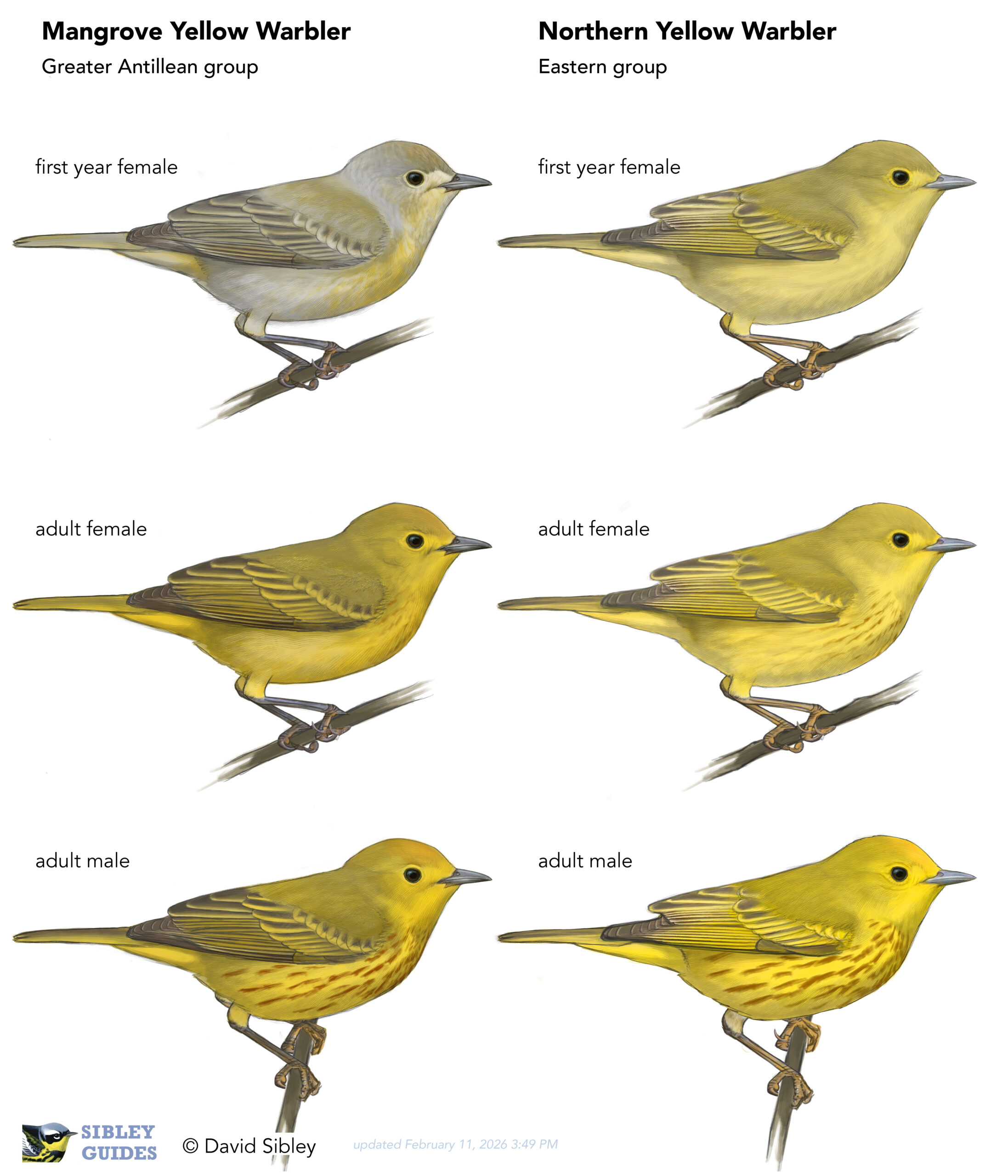
Age and sex variation within these species can be broadly understood in the three categories shown above. Seasonal changes are minimal.
- adult male, brightest and least variable, with obvious rufous streaks on underside (and rufous head in Mexican populations of Mangrove Yellow Warbler)
- adult female, not quite as bright as adult male and mostly lacking rufous
- first-year female, drabbest and most variable, some are close to adult female while others are extremely drab (first year male in fall and winter can be similar to first year female or to adult female, becoming similar to adult male in spring and summer)
Most helpful features
- structure – as described in my previous post, bill shape, wing shape, and undertail covert length offer subtle but useful clues for ID.
- Overall color – Mangrove averages drabber and darker overall, and first year birds (especially females) can be very drab with gray nape. Both species are quite variable, but a brighter and “cleaner” yellow look is indicative of Northern, and a drabber and duskier look indicative of Mangrove. Beware that many of the color differences described in this post involve subtle variation in contrast and color, which can be strongly influenced by lighting and photo processing.
- Greater covert and tertial edges – Mangrove averages broader, more diffuse, and drabber olive or grayish edges on the greater coverts and tertials, and these tend not to wrap around the tip of the feather. Northern often has narrower, more distinct, and paler yellowish edges that wrap around the tip of the feather. This can produce a more uniform drab folded wing on Mangrove, and a more contrasting pale yellow panel on Northern, but there is variation and overlap.
- flank color – Mangrove has a faint dusky wash along the flanks. Northern is uniform yellow throughout the underparts.
- throat and breast color – Mangrove has a more orange and olive tone to the yellow of the underside, subtly different from the clear pale yellow typical of Northern.
- forehead color – Mangrove averages darker olive forehead, often with a distinct orange-rufous wash. Northern has paler yellow-olive forehead, sometimes faintly orange.
- neck sides color – First year Mangrove often has pale gray neck sides, never shown by Eastern group of Northern Yellow Warbler (but common in Southwestern group). Adult Mangrove has the neck sides darker olive, similar to the color of the back. Northern typically has paler yellow neck sides, contrasting with the back and combining with the cheek color to produce a yellow-headed impression.
- cheek color – Mangrove averages darker dusky olive on the cheeks and malar. Northern has cheeks and malar paler and cleaner yellow.
- rump color – Mangrove has darker olive rump about the same color as the back. Northern typically has the rump slightly paler and yellower, especially on the sides.
Features less helpful
- leg color – Mangrove averages darker legs and feet (vs paler orange on Northern) but there is extensive variation and this is probably not very reliable.
- Rufous streaking on adult males is very similar, may average slightly thinner and continuing higher onto throat on Mangrove, but much overlap
- Tail pattern is very similar. Mangrove averages smaller yellow patches when comparing same age-sex classes, but there is too much variation and overlap to be useful.
A disclaimer
This is a first draft tackling this very complex identification challenge. I have drawn on my own experience, along with studying hundreds of photos in the Macaulay Library and specimens at MCZ (Harvard), but I have not been able to field test any of this yet. The collective efforts of the birding community and real-world testing will undoubtedly lead to a much better understanding of these two species.