

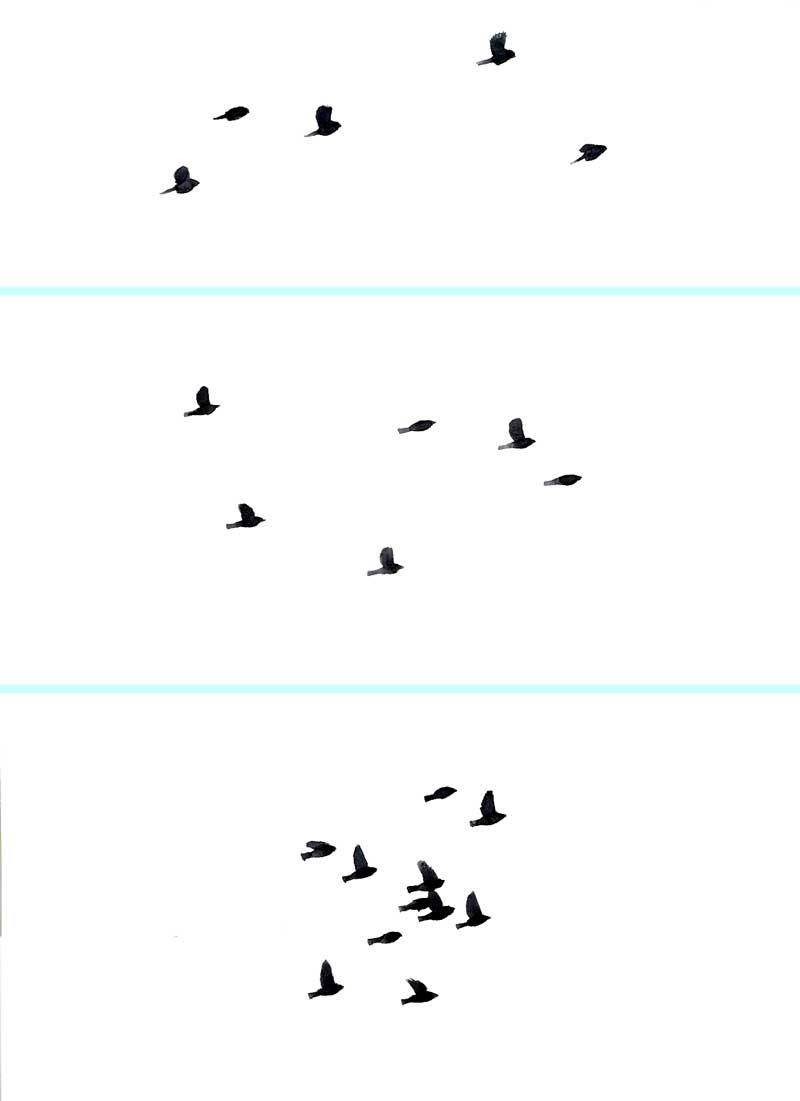
It’s early morning and you’re out on a bird walk following your guide under a gray sky. A flock of small songbirds flits over the distant treetops. The birds reveal no field marks (or so you think), so you’re surprised and mystified when the birder leading the group says matter-of-factly, “Eight House Finches.”
“How is that possible?” you wonder. They were just silhouettes flying away, no color or pattern was visible, and there must be hundreds of possibilities.
Well, for starters, there are not hundreds of possibilities. You can be certain that you will never see a flock of towhees or vireos or wrens flying over the treetops. In any given area, only a few species are commonly seen flying long distances in cohesive flocks: finches (redpolls, siskins, goldfinches, crossbills, rosy-finches, etc.), blackbirds (also including grackles and cowbirds), and waxwings. These birds tend to form neat oval flocks.
Other species that often fly in more or less cohesive flocks are larks, pipits, starlings, robins, bluebirds, Yellow-rumped Warbler, a few sparrows (Lark, Vesper, Savannah, Lark Bunting), longspurs, Snow Bunting, and meadowlarks. These species tend to form loose, straggling flocks.
It’s easy to overlook the fact that flocking is a field mark. Maybe it’s not much, but it greatly reduces the number of species you have to consider to make an ID. Expectations are one of the most powerful clues we have for identifying birds. In the same way that we build up mental lists of species that we expect to see in a certain place and time, we can build lists of species based on flying in flocks, flying in lines, diving underwater, and other characteristics.
Once we have a list of expected flocking species for our local area, it takes very little in the way of traditional field marks to identify a flock of House Finches — fairly long square tail, no markings on tail, birds not black.
Besides the tightness of the flock, other important clues to focus on when studying a flock of small birds in flight include:
- Size and shape of the birds – especially wing and tail shapes.
- Landing site – this might reveal habitat preferences: pipits usually don’t land in treetops, and Yellow-rumped Warblers usually don’t land on the ground.
- Flight calls – In most of these species, vocalizations are distinctive and frequent. The lack of calling can also be a field mark. Cowbird flocks are generally silent in flight, unlike blackbirds and grackles.
The keys to learning all of this are simple awareness and experience. If you challenge yourself to identify flocks when you see them, it will soon become second nature.
I am trying to identify flocking birds at my foothill home near Auburn, Ca. I see them only near sunset, in the fall/winter, several loose flocks of about 20. Quiet except for wingbeats, gray brown, size of blackbird, pointed wings. Usually headed northward. Occasionally stragglers will stop briefly in treetops. Can you help?
I am trying to identify a flock of birds seen perched in my front yard tree in Atwater, CA. (center of the Central Valley). The group consisted of about 30 individuals, and looked very much like ash throated flycatcher. From what I’ve found online, I don’t think that these flycatchers gather in flocks. This was the first time I’ve seen these birds, at about 8 am. One other thing…even though my dog and I moved around within 8 ft of this small tree, this flock showed no concern. What do you think? Thanks.
Cedar Waxwings have arrived in my area in Central Massachusetts. Two flocks flew overhead in a tight oval formation no doubt with eyes on the mulberry tree in my yard. They are infrequent visitors here but nonetheless a welcome sight that Summer is on the way.
While camping in NE Tennessee in late Oct., we observed a small flock of birds that landed on the ground outside our motorhome. They were a little smaller than a robin, had a rusty-red breast, black on the top of the head and around the eyes. Also, around the eyes were white markings as well as white markings on the wings. We have looked at several bird books and online to find out what these were. They pecked around on the ground basically staying together in a scattered group. When one or more fluttered on to a new spot, the others followed. They stayed around for several minutes and eventually they all flew off in a group. They most closely resembled the Black-Headed Grosbeak which does not have the white markings around the eyes.
Nondescript brownish lines and very large group. Robin sized not very noisy.
Pingback: Where Does The Horned Lark Live? – Ploverbirds.com
Pingback: What Sound Does A Spotted Towhee Make? – Ploverbirds.com
Pingback: How Many Nests Do Wrens Build? – Ploverbirds.com
Pingback: Do Warblers Fly In Groups? – Ploverbirds.com
Pingback: Do House Finches Flock Together? – Ploverbirds.com
Pingback: Do Flycatchers Fly In Flocks? – Ploverbirds.com
Pingback: What Are The Birds That Fly In Swarms? – Ploverbirds.com