For much of the year, distinguishing male and female American Goldfinches is easy (when the males show their brilliant yellow summer plumage, about March through September). Even in January and February many males have a few bright yellow feathers showing, but otherwise the gray-brown nonbreeding males can be hard to tell from females. There is very little difference between immatures and adults of each sex.
Males have really black wings with bright wingbars and feather edges, while the females have duller brownish-black wings with buffy or brownish-white wingbars and edges. This is pretty easy to judge, but it requires a bit of experience and judgment.
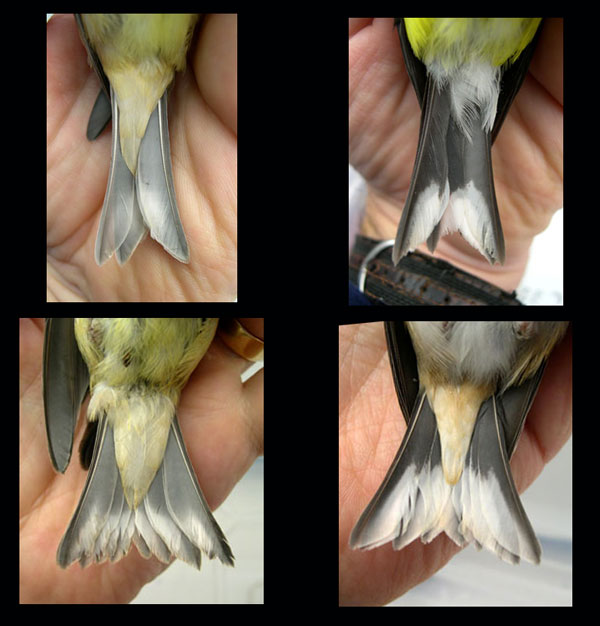
For a more objective and reliable difference, look at the underside of the tail, which is easily seen when birds are sitting on a feeder. Males have blackish tail feathers with well-defined white spots, females grayish feathers blending into dull white spots. Once you’ve confirmed the sex of a bird by the tail pattern, take a minute to look at the wings, the body plumage, bill and leg color, etc., and you’ll soon become an expert on goldfinch plumage variation.
Hi David,
Thanks for the tips. I’m quite surprised that you report that there is not much difference between an adult and baby in terms of identification. Very interesting. The differences are so subtle!
You put pictures of tails. Which one is female? Males?
Yeah I was honestly looking to read where he might say the vaginas or penis area to tell the actual difference but its all good I have the same problem w trying to tell the sex of bunnies too.
Hi David, just a question, would i be right in thinking that the same differences would be visible to other types of goldfinch such as the ones we see in the UK?
Hi Carl, According to Svensson’s ID guide, male and female European Goldfinch are distinguished only by details of head pattern. So I guess this difference does not apply there.
Which ones is male?
I saw a bird at my goldfinch feeder, Ohio. It looked buff or light tan colored, no black markings. It had the tail markings of the goldfinch but was larger than the bright yellow goldfinches also at the feeder. I’m puzzled as whether this is a goldfinch or not.
i had a couple of house finch this year along with my yellow finch. Look up a picture of those and see if that might be what you are seeing. I am a rookie at this and just put finch feeders out this year. i have had so much fun watching them. It’s a good thing my husband finds them interesting and fun to watch because he’s my boss and I am not getting near my work load done!
I have a couple of very orange colored burds that my impression are goldfinches, yet am pyzzled by the orange color. They have the black wings with white bars, bou are orange not yellow on body.
I have never gotten close enough to a yellow finch as they usually fly away but I have actually gotten close and petted it several times. I was so thrilled and have decided to give it a name. They’re my favorite.
I’m in Worcestershire, UK. On our bird feeder I’ve just seen one of the Goldfinches with white wing flashes in place of the yellow flashes. Is this possible???
I have seen several bright yellow small birds with black down the side of them and some with red on the head and gradually getting lighter down the back. Is the latter a house finch?