

The split of Yellow Warbler into two species in 2025 (by Avilist) brings a challenging identification issue into the mainstream. It is possible to identify most by plumage color (more details here), but differences in the shape of body, wings, and bill provide more consistent clues for identification.
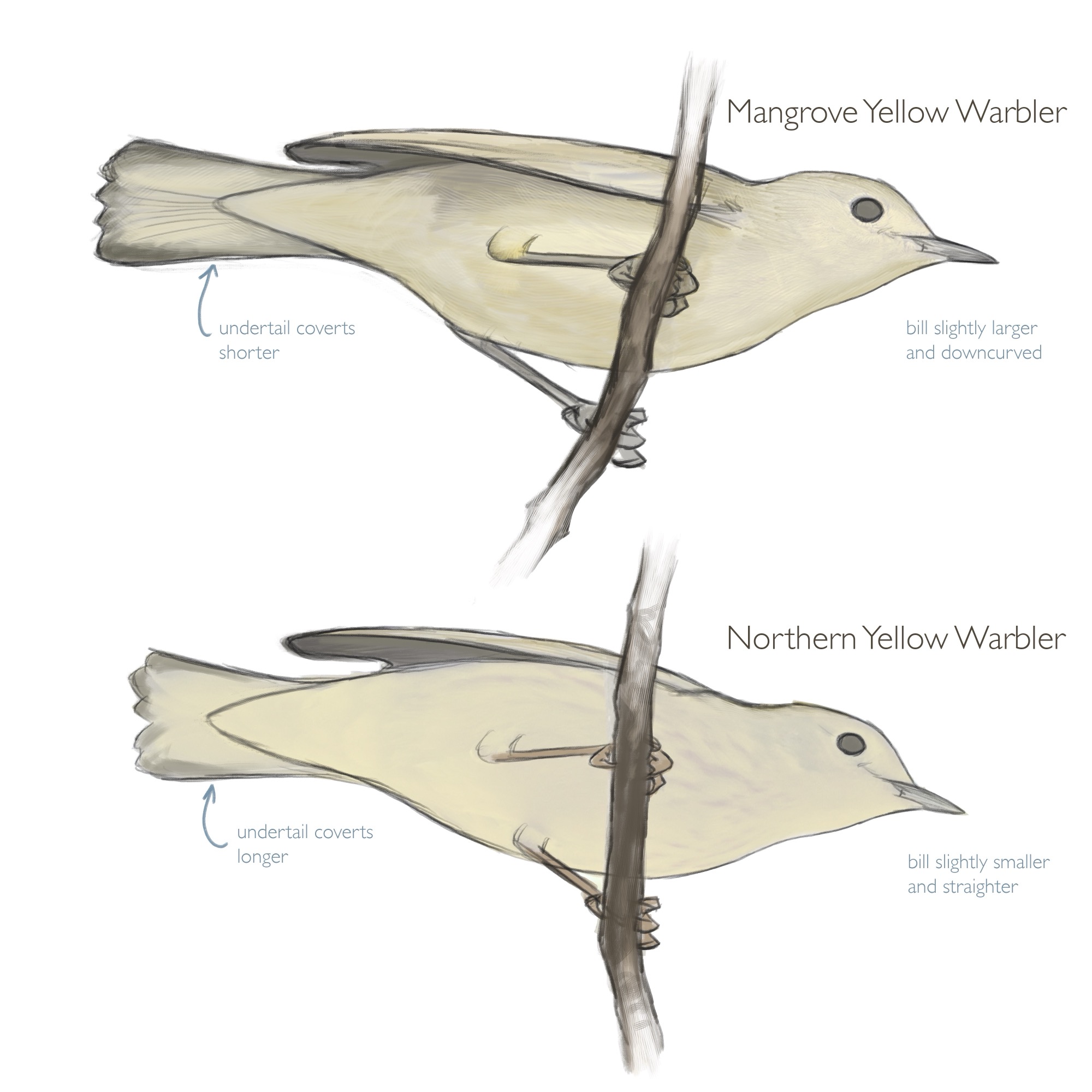
- Northern undertail coverts longer and fuller, which contributes to an overall more streamlined and torpedo-shaped body
- Northern bill averages smaller and straighter, Mangrove larger and slightly downcurved
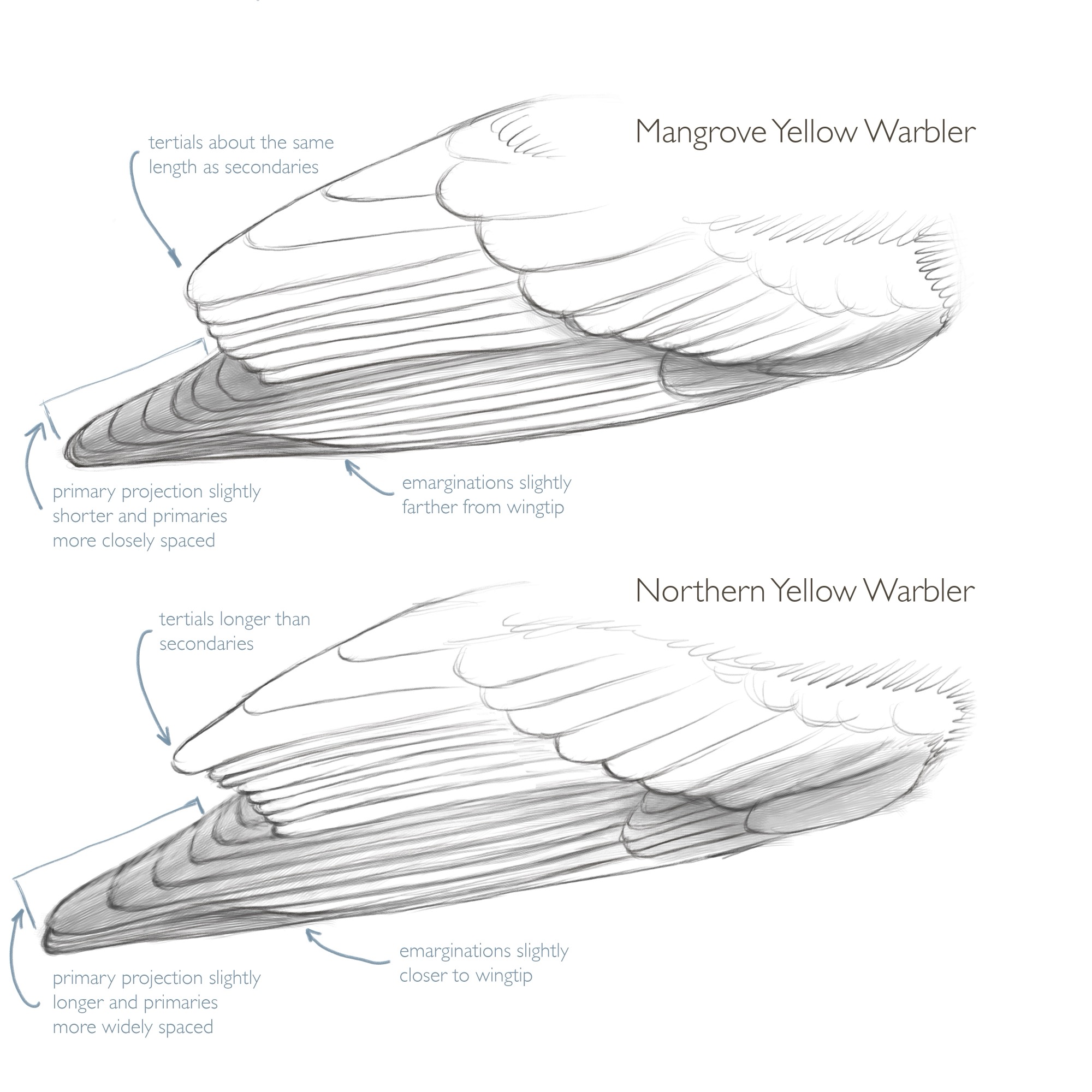
- Northern wings slightly longer, narrower, and more pointed, which is visible in longer primary projection, emarginations closer to wingtip, and secondaries shorter than tertials.
Differences in structure are mostly related to the migratory behavior of the two species. Northern Yellow Warbler is highly migratory, with some populations nesting near the Arctic Circle and wintering in South America, and it has evolved long, narrow wings and a more streamlined body shape for efficient long-distance flight. Mangrove Yellow Warbler is resident in its tropical mangrove habitat, with shorter and more rounded wings and less streamlined body, adapted for short flights.
Males of the Mexican group of Mangrove Yellow Warbler (found in southern Texas) are easily identified by their dark rufous head. Identifying others by plumage color is more difficult, and requires assessing subtle plumage differences across a wide range of variation of age, sex, and subspecies. Most can be identified by plumage, but structural differences are more constant and will always be important to confirm an identification.
Across nearly all of North America only Northern Yellow Warbler is expected, and any Yellow Warblers can be identified as Northern simply by range. In the places where Mangrove Yellow Warbler occurs – in mangrove habitat in the Florida Keys and extreme southern Texas – both species can be found and require more active identification. Northern Yellow Warbler is a common migrant and rare winter visitor in those places, and can be found alongside Mangrove Yellow Warbler for most of the year, from July to May.
There are a few records of vagrant Mangrove Yellow Warblers hundreds of miles from their normal range, and the potential for range expansion, so it is worthwhile to keep an open mind to the possibility of out-of-range Mangrove Yellow Warblers.
Differences between these two species are subtle and variable, and require good views and some experience to judge them correctly. Some individuals will be ambiguous even with detailed study, but a combination of plumage and structural details should allow confident identification of most.
Seems difficult to me. I can somewhat tell the bill, but the undertail coverts- even on the drawing seem to me to be opposite of what they should be,?
These subtle variations become easier to see with practice. Experts don’t necessarily have better vision, just a more refined ability to discern small differences. Try looking at the length of the tail projecting beyond the tips of the undertail coverts, and the relative proportions of that in the two drawings.
Dear David, this article is very helpful in tackling this identification challenge. Being from Europe, I have very limited experience with these warblers, but I tried to use your notes to identify the bird reported to Norther Yellow Warbler as belonging to this species in the following eBird list (photographed in Cuba in August 30th): https://ebird.org/checklist/S193386267. Do you agree with this identification?
Hi Mario, I’m still figuring these out, my current take is to agree this looks better for Northern. The wingtip seems long and primary spacing looks good. But the dark back, gray nape and orange crown seem more like Mangrove. I’ll check back on this one as I learn more, and I’m sure this ID challenge will become clearer as everyone works through it in the coming months and years.
Hi again Mario, I’ve just added a new post about plumage differences, and I feel pretty good about your bird being Northern. The clean pale yellow on throat, cheeks, and flanks, pale yellow edges on greater coverts, long wingtip and straight bill, all look good.
Was there any discussion of splitting the Galapagos population from the Mangrove Yellow?
Galapagos populations have been suggested as a separate species, but a recent genetic study found that the islands were colonized by Central American birds fairly recently, estimated 300,000 years ago, and they are not very different genetically. – Chaves, J. A., P. G. Parker, and T. B. Smith (2012). Origin and population history of a recent colonizer, the yellow warbler in Galapagos and Cocos Islands. Journal of Evolutionary Biology 25(3):509–521. https://onlinelibrary.wiley.com/doi/full/10.1111/j.1420-9101.2011.02447.x
David – your effort to make distinctions to facilitate its ID are commendable and appreciated. But for us in the field, who photographs them , this change is a mess. For instance, in Puerto Rico, where both are observed during migration, it is impossible to identify which individual belongs to which species. Our resident species (or subspecies) is not the Mangrove (petechia) with the obvious rufous colored head – ours is similar to the northern, some bright yellow, others duller and others with distinguishable orange stripes on the chest. Similar to what Tom Stephenson describes in his book ‘The Warbler Guide’ on page 470 as the Golden (petechia complex) gundlachi. There are plenty of similar characteristics on both species (Northern and Mangrove). As photographers, what we do to ID them in our pictures? Since we do no catch/trap them or have both specimens to compare and measure its tail and primaries, and then compare tertial and secondary, for us it is impossible to differentiate at plain sight or from our pictures.
For those of us, particularly in Puerto Rico, who are struggling with correctly identifying the two new species of Yellow Warbler which overlap in winter, I hope you will expand your description on how to tell them apart as soon as possible. I agree with Manuel’s comments.
I’ve added a new post about plumage differences, hopefully this will help with some of the ID questions in the Caribbean, but there is still a lot to learn!
https://www.sibleyguides.com/2026/02/identifying-mangrove-and-northern-yellow-warblers-in-florida-and-the-caribbean/
Hi David. I took these pictures yesterday on the coast of Puerto Rico. Mangrove YW is a resident species here; however, Northern YW is an uncommon migrant. I need help with the ID because I have doubts about which species it is. https://ebird.org/checklist/S301868584
I think this looks more like a Northern, but a lot of details that would help confirm the ID are not visible in the photos. So my impression is based on the pale and clear yellow color of the throat and cheeks, and the straight bill. The bright orange feet also suggest Northern, but I don’t know how reliable that is. And I wonder if bill color might be helpful in winter – this bird has a mostly pale gray bill, Mangrove might be darker?
I was recently birding the Caribbean coast of Colombia around Cartagena (Bolívar) and recorded numerous “yellow” warblers, and also made recordings of a couple (just chip calls, in February). In a subsequent text exchange with a highly regarded local birder he expressed to me his thinking that (at least in Bolívar) only wintering and migrating Northern Yellow Warblers occur in any numbers. There are about 55 records that people have attributed to Mangrove, presumably doing so themselves, post-split, but my correspondent noted that of the 4 with photographs all appear better for Northern, and that the general lack of records during the northern Northern Yellow Warbler breeding season suggests there is no resident population of “yellow” warblers here. There ARE mangroves, as in the trees, and some of my observations were in this habitat (where whichever sort of yellow warbler they are, they are far outnumbered by wintering Prothonotaries), but he further noted that he believes this to be a completely different species of mangrove than that generally used by Mangrove Yellow Warbler on the Caribbean islands, and that this may be a factor in their distribution. I was afterwards inspired to attribute my recordings to “Northern,” although I certainly agree with you that this is a very “young” identification and it will take some time to refine and pinpoint the best distinguishing characteristics.
Regarding the recordings, there is some suggestion here and there that the two species have sufficiently different chip calls so as to be identifiable, but so far in my explorations, mostly in Macaulay, I haven’t been able to find consistent variation that transcends geography and recording quality. My recordings from that trip, currently attributed to Northern, are here:
https://macaulaylibrary.org/asset/651926871
the above bird was not in mangroves but was in plantings in a coastal subdivision where mangroves are not far away, and the below bird was in a city park in the interior of Cartagena.
https://macaulaylibrary.org/asset/651586800
The suggestion is that the range of Mangrove Yellow Warbler is also likely misunderstood / insufficiently known–as you note, Northern Yellow can frequently and comfortably occur in mangroves while wintering in the tropics. Perhaps your third article about this difficult pair might focus on their vocalizations?
My issue is a naming one, not an identification one. Since these are separate (if not distinct) species, why not maintain the name used for the far more common and widespread one (so as to reduce confusion) and just change the name of the less common, split off species? Why have two yellow warblers? Why go to three word names? If the common yellow warbler is later found to be two species, will we need to add modifiers to both new species?