
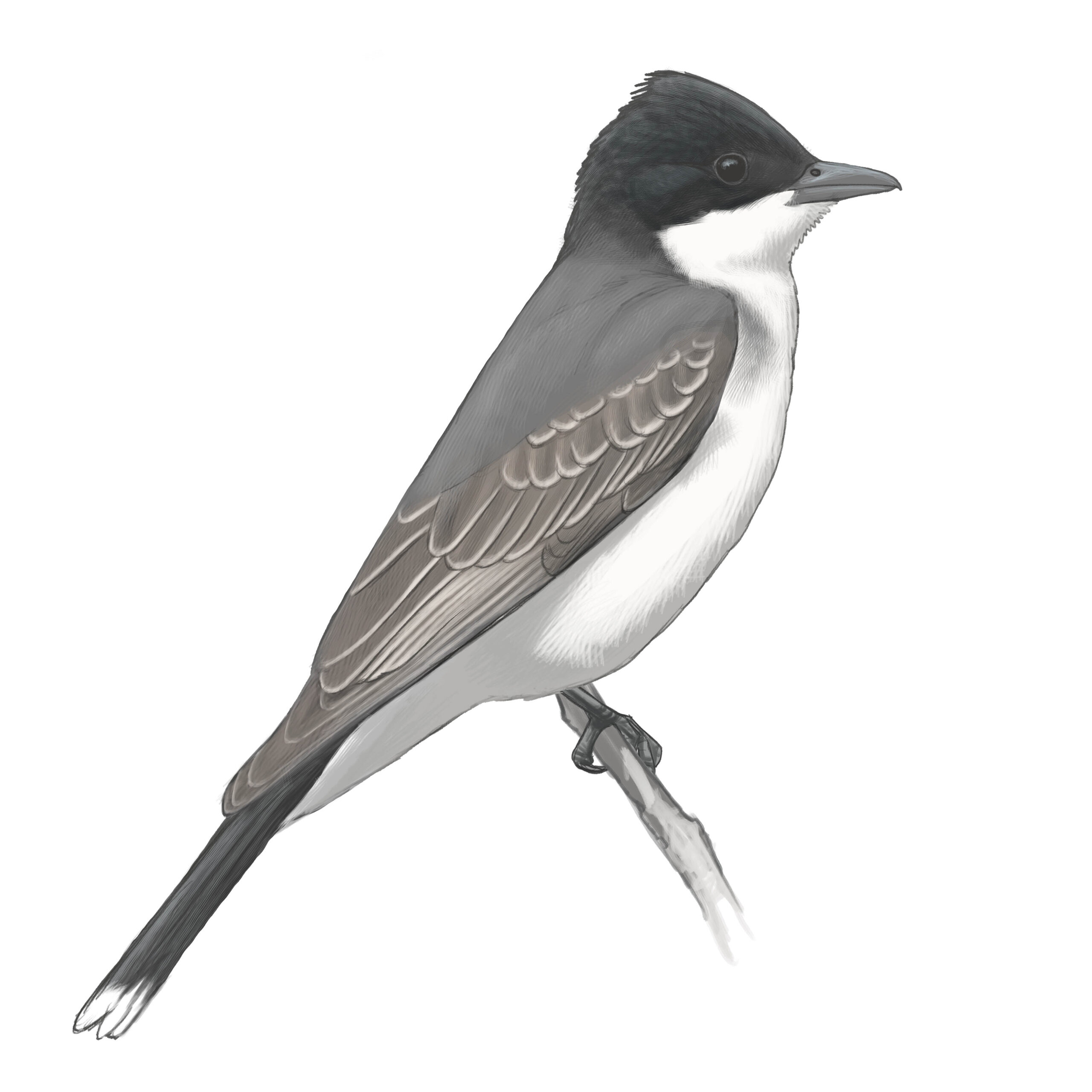
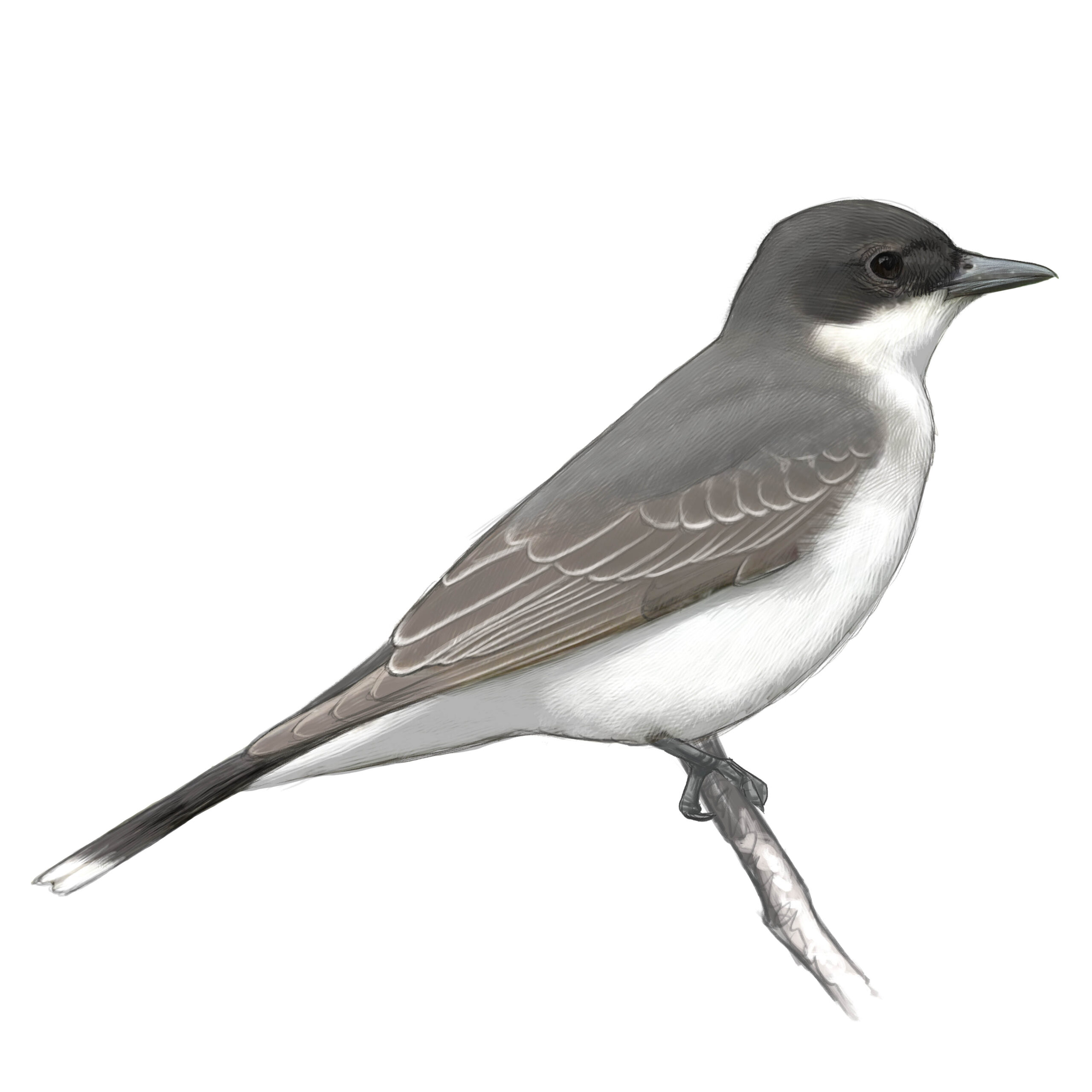
On a recent trip to Montana (June 2026) a pair of Eastern Kingbirds caught my attention – sitting side by side so presumably male and female, they showed clear differences in head shape and color. I started watching more carefully after that, and was able to check 20 or 30 more kingbirds during a week of birding. All were consistent with the features illustrated here: males have the crown taller and more triangular, with a distinct corner at the rear, females have the crown lower and more rounded without a sharp corner. In addition, the crown of males is uniformly glossy black, while on females it is dark but not quite black.
Some birds seen individually were hard to categorize, but many were obvious and I felt confident labeling them male or female even without a direct comparison. And whenever I saw a mated pair it was always relatively easy to tell which one was male and which female.
All of this should be qualified with the caveat that I don’t actually have proof that these birds are males and females. All of the pairs that I saw together included one bird of each type. And as far as I could tell the birds that I was identifying as likely males were also acting like males – calling more, displaying, chasing threats, and generally being more conspicuous e.g. perching on top of a bush while the female incubated eggs in a nearby nest.
I’ve been noticing subtle differences between males and females in a lot of species for decades, including species in which the sexes were considered identical. It is my habit now, whenever I see a pair of birds together, to study them for any potential differences in color, shape, and posture. When I saw these kingbirds I made a point of looking for differences in head shape because I’ve seen that in some other flycatchers recently (Tropical Kingbird and Dusky-capped Flycatcher, among others).
I will certainly continue watching for this in Eastern Kingbird and other species. One important question is: do immatures show different head shapes than adults, and if so when do they acquire the adult shape?