


Update 16 August: a new post Progress on the orange-throated hummingbird mystery.
Update 14 Aug 2011: A follow-up to this post is now available, tempering some of these points and adding more questions – Orange-throated Hummingbirds: more questions.
Every year in August and September, a few perplexed observers in eastern North America send out questions about an odd hummingbird they have seen. The description is always the same: “similar to the common male Ruby-throated Hummingbird, but with an orange throat.”
The species involved – Ruby-throated Hummingbird – is quickly and easily confirmed, and if these birds generate any further discussion, it is simply to suggest that they are odd males, with worn or otherwise degraded throat feathers. Well, they are male Ruby-throated Hummingbirds, but I believe that the rest of that speculation is wrong. They are apparently typical males in non-breeding plumage! (Update: the orange-throated males seen in late summer apparently are worn – see my later post Progress on the Orange-throated hummingbird mystery – but the orange-throated specimens from the wintering grounds probably represent a nonbreeding plumage).
Hummingbird molt
Ruby-throated Hummingbird was thought to molt all of its feathers just once each year, in a complete molt on the wintering grounds that ended with the rapid replacement of all throat feathers just before the birds migrated north (Pyle, 1997). Then a model study by Donna Dittmann and Steve Cardiff (2009) used thousands of photographs of hummingbirds visiting their Louisiana backyard feeders to document a previously unknown summer molt in Ruby-throated Hummingbird. Wing and tail feathers are molted only once each year (on the wintering grounds) but the head and body feathers are replaced twice each year, once in the summer, and again in late winter.
When I read about this summer molt and the “extra” replacement of throat feathers, I wondered if there could be a connection to the odd orange-throated males that are seen each fall. If Ruby-throated Hummingbirds were only growing iridescent throat feathers once each year, just before migrating north in the spring, it’s hard to explain a different throat color in the fall. But, if these hummingbirds are growing a set of feathers that will only be worn in the non-breeding season, it makes sense that there would be less selection for brilliant red throats at that season. Molting the throat feathers twice each year essentially allows the male hummingbirds to “go casual” for the winter and grow feathers that are less bright, without paying any social penalty for it. Could the orange throat be a recognizable winter plumage shown by some or all males?
The nonbreeding plumage of Ruby-throated Hummingbird
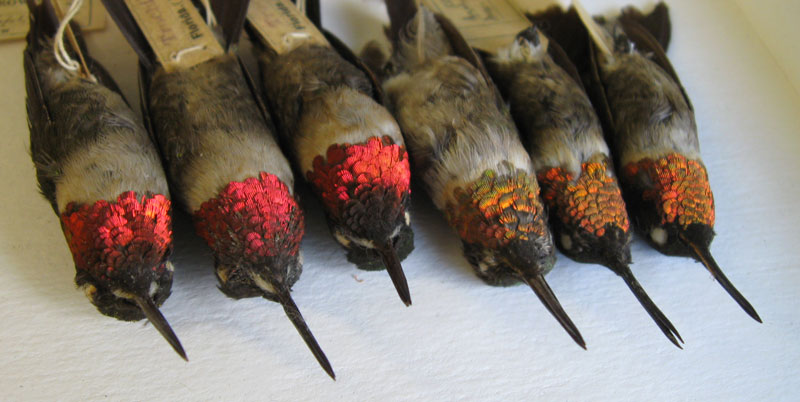
A survey of specimens at Harvard’s Museum of Comparative Zoology confirms that all of the winter specimens there have a significantly different throat color than specimens collected in spring and early summer. The photo above shows three spring Ruby-throated Hummingbirds in “breeding color”, with three winter birds in “nonbreeding color”.
The color difference can be tricky to see. Like other iridescent colors it changes slightly as the angle of view changes. For the photo shown here I chose the angle that showed the most dramatic color difference, but from some other angles the colors appeared much more similar. Nevertheless, the color difference is consistent and definite. No winter males show the deep red color of the summer birds, and only a couple of summer birds approach the more orange throat color of the winter birds. ((The few summer birds showing orange throats may be one-year-olds in their first breeding plumage, or perhaps adult males that were less healthy or had lower hormone levels when their feathers were growing. Immature males in their first fall and winter also show this orange color on the few iridescent feathers they have acquired on their throats.))
More questions than answers
Currently the biggest question is this: Is the color difference in the orange throat really the result of molt, or is there some other explanation? ((Donna Dittmann (email) reports that during her study she did not see a color difference between old and new feathers on molting males in Louisiana. Furthermore, she says that comparing specimens of fresh fall males with worn summer males in the museum at LSU shows no difference in throat color, and that the only orange-throated specimens at LSU were collected in winter in Mexico (just like the orange-throated MCZ specimens). What does this mean? I don’t know. The throat color of the MCZ winter specimens (all from Mexico and Central America) shows a clear and consistent difference from the spring specimens. If it’s true that this difference is not apparent in Louisiana immediately after molting, then something must change in the next month or two as the birds travel to their wintering grounds. They can’t go through another molt, but maybe the existing feathers change somehow. Any hypothesis would also need to explain the occasional orange-throated birds that are noticed all across the eastern US in early fall. It remains a mystery.))
And there are a lot of other questions:
- Do any other North American hummingbirds have summer molts? If so, do they also have a recognizable non-breeding plumage?
- Besides throat color, are there other parts of the body plumage that show differences between summer and winter plumages?
- Do females show any difference between summer and winter plumages?
- What is the evolutionary origin (and correct terminology) for these molts? ((For those who really like molt studies: see Dittmann and Cardiff (2009), and Howell (2010) for some discussion of molt terminology, and the debate is ongoing. If the wing and tail molt in winter is connected with the complete body molt in late winter, that must be the annual complete Prebasic molt. In that case this newly-discovered summer molt of body feathers must be the Prealternate. But if the summer molt of body feathers is connected to the winter molt of wing and tail feathers (with a pause for fall migration and restart on the wintering grounds), then that whole process would be the Prebasic molt, and the body molt in late winter is a separate event unconnected to the replacement of wing and tail feathers, and would be the Prealternate. This latter scenario is a better match for the “standard” molt cycles of birds, but hummingbirds are an unusual group, so there’s no reason to assume that they comply with any standards of molt. The answer to those questions can probably best be found by studying the exact timing and extent of molts on the wintering grounds.))
- Do Ruby-throated Hummingbirds undergo this summer molt wherever they are in eastern North America, or do they migrate to favored molting areas?
- Do all of them molt before migration, or do some migrate to the wintering grounds and molt there?
Many of these questions could be answered by careful observations by backyard birders. This is yet another reminder that new discoveries are still waiting to be made, even among the most common backyard birds of eastern North America. A well-executed study like the one by Dittmann and Cardiff can lead to new discoveries anywhere, for any species. All it takes is curiosity and observation.
References
Dittmann, D. L. and S. W. Cardiff. 2009. The Alternate Plumage of the Ruby-throated Hummingbird. Birding 41: 32–35. http://www.aba.org/birding/v41n5p32.pdf continued here: aba.org/birding/v41n5p35w1.pdf
Howell, S. N. G. 2010. Molt in North American Birds. 267 pp. Houghton Mifflin Harcourt.
Pyle, P. 1997. Identification Guide to North American Birds: Part I. Slate Creek Press. 731 pp.
Notes
Thanks to Masaharu Ishii for allowing use of his photo. Thanks to Peter Pyle and Donna Dittman for comments and discussion, and to Jeremiah Trimble and Harvard’s MCZ for access to specimens.
This is interesting.I myself have never noticed a difference in the throat feathers between spring and fall.I will pay close attention and document any that I see with a less brilliant gorget.
Just saw a hummer with a very bright yellow throat band and iridescent green wings. Looked all day through birding books but couldn’t find my bird. It’s the first hummer we’ve seen this year and the first one like this ever! We live in Ma. near the N.H. border.
HI, WE LIVE IN JAFFREY NEW HAMPSHIRE. AND I AM SURE WE JUST SAW THE SAME HUMMER IT HAD A YELLOW BAND AROUND IT’S NECK. 5/23/16
Hi–I live in Snow Camp, NC and saw a hummer today with a very distinct yellow band right below the bright ruby throat. 5/28/16
I am in Iowa and on June 7th I saw a Hummer with a bright yellow band about 1/2 inch wide all around its neck. It also had a bright red neck patch.
We saw this same hummer twice this week in Largo, FL close to the gulf.
May 28, 2017 in Northern KY. My husband and I are watching a male with the orange throat along with a male and female ruby throated hummer in our yard and at the feeders. Note: We are in mating season so it must be a yearling??
I just noticed the orange Rufous hummer for the first time. Mtns of Colorado.
I will say I noticed that around 7-7:30 pm. They just go crazy then they drink like their is no tomorrow. Then poof they all leave by 8pm
I have a humming bird hanging out this year, that is rust colored on the back and head, his throat is dark brown but when he ruffles his feathers it is a very bright neon orange. There is NO green in him whatsoever.
I live in Eastern Oregon about 50 miles NW of Boise Idaho. It’s desert country here and I have only seen the hummingbirds that are green in the back with beige speckled throats, have never seen a ruby throated hummingbird here.
Ditto to Kari’s 7.16.2019 posting. We have had feeder in front yard and just today I’m noticing this exact same color description for very first time.
We live in high desert far western Texas. This bird is beautiful and I got online right away trying to figure it out. This bird has no green or grey whatsoever; appears to have a very dark brown or blackish beak area.
We have never seen a ruby throated hummer here.
RTHUs molt contour feathers from approximately late July through October. Since the birds with the red-reflective feathers were collected in April, long after this fall molt, the surface of their feathers is not worn so shows red. The yellow-reflective feathers are obviously worn in the photo, so those feathers were not yet molted in the year the birds were collected, but were the feathers from 12 months before. The surface of those feathers is worn so refracts a yellow color. The feathers act as a prism and are not any of these colors, but are black.
Hi Cathie, I do not agree. I don’t think it’s as simple as “worn feathers”. Ruby-throated Hummingbirds molt the throat feathers in late winter, in an extremely rapid and nearly simultaneous molt just before they migrate north, so in April they are all fresh. Dittmann and Cardiff discovered an additional molt in the summer, in which the birds molt their throat feathers again near the end of the process, so the fall and early winter specimens should also be in fresh plumage. As you point out, the only pigment in the throat feathers is melanin, and it is the microscopic structure of the feather surface that reflects only a very intense and pure color. It’s not at all clear how wear would impact the visible color of those feathers. There are no pigments that can fade the way the red color of a cardinal fades over time, and no evidence of any gradual change in color as the feathers get older. I would expect that any damage to the surface of the feather would simply result in “lights-out” and a dark gray or blackish appearance. I can’t see how wear would produce a slightly more orange color, as that requires a very precise alteration of the structure. It could happen, I guess, but many things argue against it in this case.
i surmise feather color must come from protein. the feathers are the color of the food the knats eat. orange; oranges, banana: yellow, etc. there appears to be a correlation in ‘environmental group color’. food, sun, circa (sleep cycle). hummers family, friends and foes probably play a community role.
Thank you Kathy!
I catch many AHY-M birds (actually all AHY birds molt all contour feathers at this time) in all stages of molt between July and September, and I have never seen males with gold colored throats after they molt, always red. Perhaps the birds you found with non-red throats are simply an aberrant group and not standard. I have banded about 36,000 RTHUs since the year 2000, and have not seen the golden gorget feathers that your birds show. I work in southern Illinois and southern Indiana where the population of RTHUs is extraordinary (as well as in southern Missouri) and we get migrants from farther north as indicated by recapture data. I have seen a golden color refracted from the feathers, but when the angle of view is changed, they show red.
OK, it’s good to know that you speak from some experience. And thanks for answering one of my questions – that all adults molt in late summer. Regarding the next question on my list – do your “migrants from farther north” arrive and then molt in your area, or are they passing through after already molting on their own summer grounds?
On the orange-throated question, you are saying basically the same thing Donna Dittmann said – that males look just as red after their fall molt as before, and that maybe the MCZ specimens are an “aberrant group”. I am resisting that explanation because it’s just too easy, and seems very unlikely. There are about 20 winter specimens at MCZ and all of them are orange-red.
One possibility, as I said in my post above, is that something happens between the summer molt and the wintering grounds. Maybe the new feathers grown in the fall look the same red color at first but lack some critical structural feature, so that over a matter of weeks the color changes to more orange?
I would also submit the idea that the color difference is subtle enough to be missed if you are not actively making comparisons and looking for it (with all due respect). All of the specimens look “red” at a glance, until you sort them into summer and winter and then the differences are apparent. As I said above the photo shows the most dramatic difference, and it might be misleading you. The difference is not that obvious most of the time. The fact that you’ve never seen an orange-throated male in all of your banding suggests to me that you might be missing them, since birders do report them occasionally in the eastern US in late summer. Maybe this fall you could use some color swatches and match the throat colors of adult male hummers, to see if there is any variation in throat color and if it correlates with molt?
I have one male hummingbird and two females at my house. About a month ago I took a picture of the mail and his throat was orange. His throat is now red. One of my females looks kind of fat so I believe it does have to do with mating.
I said that I never see a gold colored gorget in a male in the fall AFTER it completed its molt, only red gorgets. Indeed, the ratty looking males sometimes do have a gold cast to their gorgets, but those are the feathers they are loosing, not gaining. I don’t think that I would miss an orange colored gorget on a RTHU AHY-M, even if I was very busy; I have often been accused of having extraordinarily good vision, both in detail and color. I do see gold gorgets occasionally, but as I said, only on those molting and only the old feathers. I cannot tell, as you know, a migrant from a local bird by molt, time of year, or anything else. I (and my co-authors) have published 2 papers using isotope analysis to figure out where HY birds came from and what migration pattern is suggested by testing feathers from HY birds caught in Central America, but with adults, one can’t be sure where the feather is actually molted, unlike HY birds which grow feathers while in the natal area. Your question might be answered by contacting my fellow RTHU banders across the range to find out what they see in the fall contour molt in RTHUs. You could also contact the MOSI group to find out about the occasional AHY-M RTHU they capture during their banding program in Central America. I do agree with Donna; sometimes simple is right.
Thanks Cathie. I agree simple is often right. In this case I had a simple explanation (fresh feathers after the fall molt) but that doesn’t match your observation that freshly-molted birds are red-throated. You also have a simple explanation (worn feathers before molt) but that doesn’t fit my observation that all winter specimens are orange-throated. So maybe neither one of us is right, and the answer is something else. I think it remains a mystery.
I have had an orange throated one that is protecting the feeder, he perches on top and runs all the others that come close he even runs the starling from my other feeder, it’s cute to watch he doesn’t seem to drink any, just perches on top of the feeder.
Hi Debbie, That sounds like the behavior of a male Rufous Hummingbird, which do have orange throats, and are common in the west (if you are east of the Rockies it would be very rare). Are you sure of the species?
I’ve been thinking about the difference in gorget color, and wondering if it’s based on a lower hormone level in the fall. I don’t know if that kind of chemical test is available and whether feathers from the specimens you cite could be used in a test, but it would be interesting. That might explain a slight color difference since the males are not concerned with breeding during that molt. My other question is when would the second molt occur? Around here it seems the males molt in the late part of July and in early August. However, the first birds returning to US are in late February, which would have them beginning a molt in December or January. Maybe they molt just the gorget to look beautiful for the girls. Perhaps a check with those southern hummingbird banders who see so many wintering birds to ask about a gorget molt would be helpful. They of course deal with mostly western species and not RTHUs, but it might lend some insights.
Good suggestions, thanks! Most feather color is controlled by hormone levels during feather growth, and I assume iridescent colors would be the same. I don’t know if those hormone levels show up later in the feathers, though. In the case of most bright colors the birds have to create the red and yellow pigments, and therefore it is “easier” or less costly to grow feathers with drabber colors. In the case of iridescent colors I’m not sure how that system translates, that is, in the summer molt they grow feathers that are “easier” and take whatever color they end up with, but are orange feathers easier to grow than red ones?
I have no personal experience with the winter molt, but it does seem possible that (like many other brightly colored birds) they molt only the flashy feathers for the spring. However, that should show up on one-year-old males, which would retain their juvenile body feathers through the spring migration and should look very worn. (And note that Sheri Williamson has just suggested on her blog that the summer molt might be very limited and the spring molt complete?) If you know anyone who handles winter hummingbirds it would be great to get their insight on this.
I found an orange throated humming bird dead the other day here in ohio. I just thought it was alittle less red but it had an orang throut. Are they still the same species or are they conciderd differend species?
It’s all the same species – Ruby-throated Hummingbird (unless it was orange all over and in that case it would be Rufous or Allen’s Hummingbird). Did you take photos of the throat, or save the specimen to donate to a museum?
May 12, 2012…..just saw my first orange-throated hummer. Rushed to your website and found that it was not so unusual. We are in Holden, MA. Will keep watching to see if he stays the same all summer.
May 31, 2012,
I saw my first orange-throated hummingbird at some flowers on our deck, within the past two weeks. Its throat was very bright iridescent orange (not ruby and not dull) and I noticed the top of its head was not green, but seemed to have a small, dull, light grey cap, other than that it looked just like our ruby-throated hummingbirds. Today I saw another hummingbird at our feeder that appeared to be a female (no throat patch) but with the same small, dull, light grey cap on top of its head. We normally only see male or female ruby-throated hummingbirds here, Columbia, MO.
I am 56 years old and have never until today seen a hummingbird like the one I saw today. Near Waco Texas I saw a neon orange throated hummingbird feed at my feeder. It only stayed a few minutes and I have not seen it since.
I saw my first orange/yell throated hummingbird at one of my feeders. He has been with me now almost a week. He dominates that particular feeder and only allows one particular female to feed with him.
The hummingbird I wrote about back in August is still coming to my feeder. He is definitly neon orange around his throat and he is also aggressive around the feeder. I have seen him for the past week here in Waco Texas.
I Had a cal trans all orange hummingbird at my feeder yesterday, very aggressive chasing all the other hummers away. I saw him this morning but have not seen him rest of the day. He is probably just passing through on his migration!!!
Hi Cindy, I’m guessing you’re in California, and a bright orange-colored hummingbird this time of year is likely to be an adult male Allen’s. In almost any other state it’s more likely to be a Rufous Hummingbird, and pretty rare this time of year. Both species are very aggressive, known for defending a feeder against all other hummers.
Cindy/David: Your bird has shown up in Medford Oregon about 4 days ago. The whole body is orange but with the most electric orange throat, I call him butterball because he is sort of fat. I have half a dozen birds comming to my feeder all year in spite of a ruthlessly cold start to winter, but it turned warm in February and has been a very warm March, I now have maybe a dozen birds visiting my feeder. I have never seen anything like this hummer, in weak light early A.M. or just before sunset he looks all red, but in broad daylight he is almost totally orange, with a few lighter buff patches on the underside of the body and wings, but his throat is like an orange laser when he turns just right. I will try to get camera footage to post at Youtube on my phone today.
I have just seen a male hummer at my feeder with a bright yellow band around the throat. I was not able to get a photo. This was not orange, it was distinctly yellow. April – not molting season. I have mostly Black-Chinned hummers and some Ruby-Throated. I am in the Austin TX area. ????????
Hi Sandy, Interesting! The most common cause of yellow on a hummingbird’s head is a dusting of pollen from flowers. That has a pale “chalky” yellow appearance, not iridescent. At different angles, as I suspect you know, the iridescent feathers of any hummingbird can show odd flashes of pale green or gold. If what you are seeing is a clear band of iridescent yellow that would be very unusual. I’ll be interested to hear more about it and please post or send a photo if you can get one.
I live in Michigan, not the U.P. but we still call it northern part of Michigan and today while eating lunch my husband pointed out a hummingbird with the brilliant orange neck! This is the very first time ever that we have seen one. I was able to take a few pictures of it thru the window & screen. If interested in seeing my photo you can email me and I will send it to you. What a great moment to capture!
Sincerely,
Suzanne
David – was pointed to this discussion (very late, obviously!) and thought I would chime in on behalf of Nancy Newfield, who is the bander I have been assisting for the last eight years.
Her studies include two main projects: a breeding season/migration study of Ruby-throated Hummingbirds, and her well-known documentation of wintering hummingbirds here in Louisiana, which include quite a number of Ruby-throated as well.
Our experience shows that adult birds begin molting immediately after completing breeding activities. Males begin first (since their “duties”, limited as they are, are done sooner, and local breeding birds ordinarily have completed their post-breeding contour molt by early August. By mid-August, they are mostly gone and virtually none are ever seen after the end of August. Females appear to start molting as soon as the young fledge (for those that manage two successful nests in a year, after the second set fledge.
Because of differences in the timing of beginning and completing nesting between birds here at the southern end of their range and those up north, the dates by which molt begins and is completed probably vary. Nonetheless, migrant adults (those birds carrying significant fat loads), from the moment they appear, gradually replacing the departing breeding birds, are almost always completely finished with their molt when captured. Nest marks on the females are gone.
Our wintering Ruby-throated birds are a bit of a mystery, since we have very little data to identify where they come from (one banded in south Louisiana later recovered dead in Manitoba). That said, a great many of our young male Ruby-throated winter birds seem “behind the curve”. Very plain throats with few or no red gorget feathers is the general rule, and they frequently carry this plumage well into the early spring when adult males are already returning in fresh spring plumage. It is possible that a good many of our wintering birds are late hatches that simply don’t complete migration because they started late; the photoperiod clock that seems to trigger migration’s beginning may also signal them to stop here, as they’ve arrived here at a time when they should have been arriving on their Mexican/Central American winter grounds.
What we HAVE observed is that the gorget and the forecrown are the last two areas to complete molt – and this is true of adult birds that overwinter here as well as the young ones. This suggests that a wintering bird collected in, say, January would have been wearing his gorget feathers since late July of the previous year, so they’d be in roughly the same condition as a breeding bird’s would be in early July – ie worn. The question would be – are these “winter” birds ones that were collected in October when they first show up down in the tropics, or were they collected in January or February not long before molt would have replaced the feathers again?
Hi Kevin,
Thanks very much for joining the discussion. If I recall correctly a lot of the specimens I was looking at from Central America were collected in the early winter – October and November – and all through the season. Also, the drab winter color did not seem to be a gradual decline over time, but more or less consistent through the whole season.
I wonder if you can shed any light on this question: When overwintering adult males are acquiring their bright spring gorget feathers late in the winter, can you see a contrast between the color of new and old feathers? Based on the specimens that’s what I would expect, but it would be nice to have some confirmation.
Best,
David
We definitely have an orange – or should I say gold or copper – throated hummingbird guarding one of our feeders. My husband remarked on him a few days ago and today I got a really good look. Lustrous-looking feathers, not a bit drab! We had several Anna’s males all winter — this looks like an Anna’s but definitely not red.
We get migrating Rufous here, but it is too early and this guy is the wrong size. It’s hard to get a good look because they are so busy chasing each other around.
I am Arizona in the foothills of the Pinals (about 3600 ft).
Interesting. I think Rufous could be showing up already there, but a male with an orange throat would also be very obvious with an entirely orange-rust colored body. Anna’s shows quite a bit of variation in throat color, as in the Ruby-throateds described in this post, so maybe it’s an Anna’s with the color more orange-red than normal? If you can get a better view, compare size and shape and especially tail shape and pattern with the other Anna’s, and I would be happy to look at any photos you can get.
Apr 16 2014 Greenville SC Just observed an orange throated hummingbird at my feeder. Very distinctly orange. Males just arriving here.
Today I seen an orange throated hummingbird at my feeder and was able to get a really good detailed picture of him. He was very aggressive towards another male. I am in southern Ohio and it’s mid June. We would love to share our pictures with you!
An orange or gold throated hummingbird was at my feeder on June 19th, 2014. Nokesville, Virginia.
I just had an orange throated hummer at my feeder. He was a little smaller than usual. I assumed maybe it was a young one or something. I am in western pa and it is the first one I’ve ever seen.
I have beautiful Orrange Throat Hummers at my feeders.VeryAggressive toward other males
I Live In Arkansas. This is my first year to feed them and I will definitely be feeding them next year..I Love it.. ; )
I just saw beautiful gold (orange) throated Hummer at my feeder about 40 miles southwest of Atlanta. As previously described by others there was a lot of very aggressive behavior activity. While I’m a novice, I’m pretty sure there was breeding activity in my tomato plant which is in a container on my front porch.
I have an orange throated male hummingbird, very territorial, at my hummingbird feeder. He has been here for at least a month. He has black velvet feathers where the ruby throated have green. He also has a darker breast as the others have light grey. This is the first year I have seen an orange (like tangerine orange) throated hummingbird here in Northwest Arkansas. I have put hummingbird feeders out every year for the last 12 years. I have pictures as well. I was very pleased to read the other posts to know he is not the only one.
Hi Andrea, Thanks for the report. Your bird sounds really unusual, being darker than the normal Ruby-throated Hummingbirds and with a bright orange throat. I’d be very interested to see photos which you can attach to a message through the contact link above, or just send a link if they’re online. Thanks! –David
I have an orange-throated hummingbird aggressively guarding one of my feeders. He just arrived yesterday or today. I live about twenty miles southeast of San Antonio. At first, I thought he was a Black chinned, because, when he is at rest, unless he turns his head,I can’t see any band color. But when he turns, or whenever is flying, the orange is very obvious, exactly where the Ruby throats have their red. We have had Black chins at our feeders until July this year, but they left. Then Ruby throats came and are still here. It has been an unusual summer for hummingbirds, but I never expected to see an orange-throated one! Thanks for your comment section! Now I know I’m not crazy!
I have been able to get a few photos of the exact orange throat hummingbird, when perched at feeder throat appears white. When hovering or chasing off intruders it becomes a bright orange.
I came upon this article after a hummingbird with an orange throat and I surprised each other in the forest of uppermost Manhattan on 9/17/14. He was feeding on the wild jewelweed now in bloom in the woods, and the throat appeared to be the same vivid color as the flowers. Thanks for the explanation! In decades of enjoying the birds, I hadn’t seen this before.
I just saw another. I was holding the feeder when he sat down. He sounds a lot different than the others too. A deeper thicker sound.
I live in southern Arizona, have seen a thousand hummingbirds each year, and just ten minutes ago saw the orange-throated one for the first time. Wow! So I came to this site to look it up.
I live in the San Francisco Bay Area, and saw an orange plumed, and orange throated hummingbird just now. It had a white band just below the throat, and brown along the edge of his wings. It was the most brilliant orange I have ever seen on a hummingbird. I hope he comes back.
Hi Ava, In that area there are two species of hummingbirds with bright orange throats and mostly orange body plumage – Allen’s Hummingbird and Rufous Hummingbird. Check out some pictures of those, your description is a good match for either one.
I only have a few humming birds in my yard and it took forever to attract them but it is totally worth the time and patients. We just witnessed a bright (iridescent) throat on one of the visitors to our feeders. It fits the pattern of the molting birds that have been mentioned in the articles I have read here but we also still have red throats here. I have never noticed one before. We are located in South Eastern Michigan. hoping to see him again.
I’m a little late to this thread, but many RTHU’s show up in Central Louisiana in the spring with orange gorgets. I just took a photo of one this weekent. Maybe the answer is as simple as some RTHU’s have orange throats.
5 years ago (2014) we had an brilliant orange throated male visiting our feeder (near Grand Rapids, Michigan) all summer, beginning in May, along with two red throated ones. Every year since then we have had an orange throated male, again from spring until fall. His orange color is a brilliant tangerine! We have several juvenal birds feeding in the later summer and fall each year and of course several females. In 2018 we had TWO orange throated males. Possibly one is the offspring of the other. They arrive here orange and remain unchanged and brilliant all summer and depart as brilliant as ever! They do not look like the specimens in your photos. They are brilliant tangerine when viewed head on. This year, 2019, I have just one orange throated male along with our usual red throated ones and females.
Were these hummingbirds in a row killed for the study?
I live in NH and I have the ruby red throat and the white neck which I know is the girl, but today a gold neck one showed up with the other two? He was gold not orange? any ideas of who he might be? I sit on my porch and they come right up to me when I am sitting out there.
I wrote to tell about a beautiful golden throated hummer that came to my feeder. I have never seen one such as this. I am in the town of Day, N .Y. which is up in the Adirondack Mountains.
I had just filled the feeder and stepped inside the porch. I turned to look back at the feeder
and saw an amazing sight! There were three hummers just about wing tip to wing tip hovering
before the feeder. The smaller golden throated bird was in the middle. The two hummers
on each side of the smaller one were a little larger. I have never seen three hummingbirds in a
formation like that, they always chase each other. It was amazing! They did not feed but just flew off. My thought was that it was a family group, with the juvenile in the middle, just showing him the neighborhood. Is that possible? Has anyone else ever seen such a group?
Do hummingbird parents help the young ones after they leave the nest? I so wished I had
a camera at that Very special moment.
I wrote to tell about a beautiful golden throated hummer that came to my feeder. I have never seen one such as this. I am in the town of Day, N .Y. which is up in the Adirondack Mountains.
I had just filled the feeder and stepped inside the porch. I turned to look back at the feeder
and saw an amazing sight! There were three hummers just about wing tip to wing tip hovering
before the feeder. The smaller golden throated bird was in the middle. The two hummers
on each side of the smaller one were a little larger. I have never seen three hummingbirds in a
formation like that, they always chase each other. It was amazing! They did not feed but just flew off. My thought was that it was a family group, with the juvenile in the middle, just showing him the neighborhood. Is that possible? Has anyone else ever seen such a group?
Do hummingbird parents help the young ones after they leave the nest? I so wished I had
a camera at that Very special moment.
I may be duplicating these facts but I really would like to know if anyone else ever experienced
such a sight.
It is September 19 I have just noticed male hummingbird with a gold throat. Its feathers appear to be in a molting state, is this normal?
Edwin Johnston
Newnan Ga.
I have an orange-throated ruby-throated hummingbird visiting my feeder now. After doing some research, I discovered your writings on the subject. Extremely interesting articles, and hummers!
A bit late to this thread, but I had a feeder encouter yesterday that might help answer a question or two.
Lebanon, Oregon. March 19, 2022. A male ryby-throated visited my feeder. He had bright orange, rather than ruby-colored chin feathers.
This is a rare sighting in the west.
We are in West Tn and it is May 28th and we saw our first orange throated hummingbird 2 days ago and I’m watching him now as I type. Aren’t they in mating season now? Why is he orange and he is not a baby
4/20/2024 in East Texas. I was watching my hummies I had a bright red throat male and noticed a new male yesterday. I was just watching him this morning and he has the orange throat- which led me to this website trying to find out why some had bright red and some have a beautiful orange. I will continue to watch and see what else I get this year as now I’m even more curious.
I had a hummingbird visit my feeder with a glitter gold throat. I was able to get very close and he never moved away from me. He just sat there and would take a drink then lay his head back closing his eyes and rest. I was able to walk all around him so I could see him in different light angles. He was fluffy and fat. He visited my feeder June 3rd in NE AR for two days and then left. He didn’t pay attention to the other hummingbirds around him. Not sure how to attach a picture. He just didn’t act like all my other ruby throat hummingbirds.
I’m in Enterprise Alabama and I have a feeder on my window in the backyard and one on the front of the house. Today is July 30 2025 and a hummingbird with an orange dot on his neck is feeding from the feeder. I have also seen the Ruby Throated HB also along with the green feather HB. They are very aggressive with each other as they defend their feeder. Often the green feather hb tries to take over front and back. But today the HB with the orange dot defeated his territory. I am loving watching these birds in action. This is the third year they they returned and the first year for the one with the orange dot.🥰