

In The Sibley Guide to Trees I refer to some species of trees as having leaves (or needles) two-ranked, and several readers have asked me to clarify the meaning of the term. In the introduction of the guide on p. xxix the term is mentioned and illustrated with one example: American Elm has leaves two-ranked, emerging from opposite sides of the twig 180 degrees apart, while Tulip Tree has leaves arranged spirally, emerging at all angles around the twig.
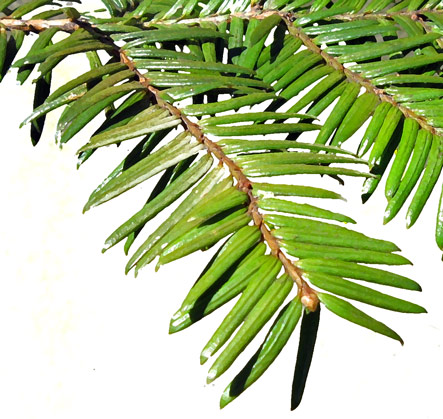
The two-ranked appearance of leaves is mentioned most frequently and is most useful for identification among the conifers, and can be seen in Yews, Hemlocks, and on the lower branches of most Firs. On the other hand, pines and spruces never show a two-ranked arrangement of leaves. On firs, only the lower, non-fertile, branches show a tendency towards two-ranked leaves, while fertile branches higher on the tree have needles pointing out all around the twig or, in many cases, all curved up.
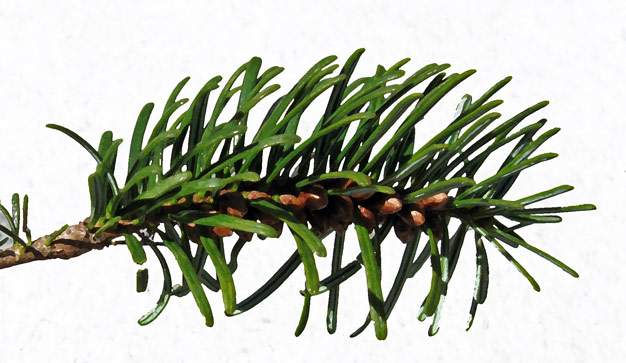
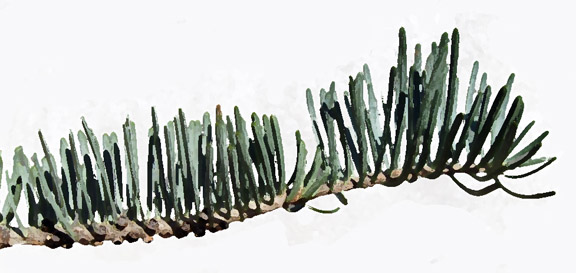
Leaves, especially those with long stalks, bend and curve to find sunlight and to place the surface of the leaf at the optimum angle, so the eventual position of the leaf is often unrelated to the position of the bud on the twig. For example, all of these conifers have leaf buds arranged spirally all around the twigs, it is the curving of the needles that determines the two-ranked appearance.
Among broadleaf trees, Elms (which have two-ranked buds and very short leafstalks) always tend to show a two-ranked arrangement. In most other species, a two-ranked arrangement of leaves is simply an attempt to capture maximum sunlight, and can be seen in almost any species of tree, particularly on lower twigs in the shaded understory.
so if I’m getting this correctly, two ranked leaves are essentially the same thing as “opposite” leaves? can “alternate” arranged leaves be considered as two-ranked?
Hi Mark, Alternate leaves can be two-ranked also. Opposite means that wherever leaves emerge on a twig there are two leaves opposite each other on the twig. Alternate means that wherever a leaf emerges there is only one, and the next leaf above or below that will not be on the same side of the twig, they alternate. I use two-ranked to refer to leaves that grow out in the same plane, as if it has been pressed, even though those leaves may emerge from the twig at multiple angles. Hope that helps.
Does ‘two” refer to the number of directions that the leaves point?