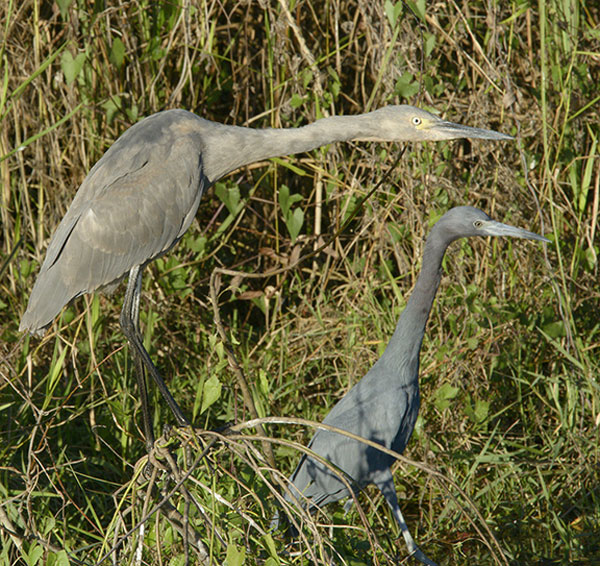

Dark heron/egret
Can you identify the two birds in this photo?
Backyard Bird Discoveries While watching a small flock of juncos at my bird feeder on December 17, 2012, I noticed one particularly brownish female. Considering subspecies and watching it a little further I noticed that it seemed more active and alert, darting around quickly and holding its body more upright than the other juncos. Could this
Posture and shape distinguishes male and female Dark-eyed Juncos Read More »
Almost every Rusty Blackbird that I see in the eastern United States is in flight, so the simple trick is to look up. In order to do that you need to know what to look for: I use sound to know when to look, then look for flying blackbirds that are solitary or in small
My trick to finding Rusty Blackbirds Read More »
Join me on a WINGS/Heritage Expeditions cruise 21 June to 4 July 2013 to search for nesting Spoon-billed Sandpipers in Siberia. I’ve always been fascinated by Siberia. Growing up in the lower 48 states I dreamed of seeing birds like Steller’s Sea-Eagle, Siberian Rubythroat, even Middendorff’s Grasshopper-Warbler, and the crowning jewel of the Siberian specialties
In search of Spoon-billed Sandpiper Read More »
Most Passerines only hold juvenal plumage for a few weeks, quickly molting to a more adult-like plumage soon after they fledge and before fall migration. It’s a plumage that is seen almost entirely on the breeding grounds, but the breeding grounds (and fledging time) of many birds overlaps broadly with the fall migration of others,
Juvenal plumage of songbirds: Gray Catbird Read More »
These are the only regularly occurring herons that are truly difficult to identify, as immatures of these two species are variable in bare-parts color and distinguishing them can require very careful study. The best clue is foraging posture, which can be seen at any distance and is very reliable. Most individuals are fairly easily separated
Distinguishing immature (white) Little Blue Heron from Snowy Egret Read More »
First Glance A quick judgment of the ground color of the breast and eyebrow stripe will separate most waterthrushes: bright white on Louisiana, yellowish on Northern. A yellowish waterthrush is definitely a Northern, while a whitish bird could be either species. Next look at the shape of the eyebrow stripe, which broadens to the rear
Identification of Waterthrushes Read More »
Identifying the white herons and egrets can be a challenge. We must rely mainly on structure, behavior, and the color of bare parts like bill and legs, because plumage offers very little in the way of field marks. One aspect of plumage can be very helpful, however. By looking at the shape and condition of
Determining the age of white egrets and herons in late summer Read More »
This is a bird sound that I recorded in August in Massachusetts. Listen to the recording and see if you can guess what it is. Some hints are below, and when you’re ready just follow the link for the answer. click to Read the Answer Hints It is a small bird, but larger than a
A little-known bird sound Read More »
The flippant answer is “…because they look alike”, and they can be very alike. Most of what you read about yellowlegs will tell you to look at bill length to distinguish the species. The bill of Greater Yellowlegs is actually longer (50 mm or more, compared to Lesser’s 40 mm or less) but birders deal
Why are Yellowlegs hard to identify? Read More »